This article is adapted from my talk at this month’s 43 Talks in-person event. When the host, Li Jigang, invited me, he gave me just one keyword: context. I wanted to start from the agent’s point of view and discuss one judgment: as models and harnesses gradually converge, what really determines the limits of an agent’s capabilities will increasingly be context.
Note: the text offers a light interpretation of the slides; the illustrations are slides exported from the talk’s deck (in Chinese), made with the Guizang PPT Skill.
Five core judgments
- Model capability and context evolve together and take turns being the bottleneck; after each round of improvement in model capability, context becomes more important.
- Models are devouring the harness, but they can never devour context, because context is not a capability; it is fact.
- An agent’s ceiling is not the model; it is context.
- Whoever owns the user’s context owns everything.
- Manage context well, and the agent emerges naturally.
A talk about context
Hello everyone. Today I want to share what I presented last week at the 43 Talks in-person event. Thanks to 43 Talks and Li Jigang for the invitation. Jigang gave the talk just one word as its theme: context. I wondered what else there was to say about context. There are already many experts in the field; some talk about engineering, others about product.
I wanted to take a slightly different angle. I have recently been working on agent infrastructure, and I am also a heavy user of agents myself. For a long time I have been thinking about the value of context in the whole agent ecosystem. So I came up with a title: “Context Is the Agent.”
What follows develops the talk from that angle.

The bottleneck doesn’t move in a line; it spirals upward

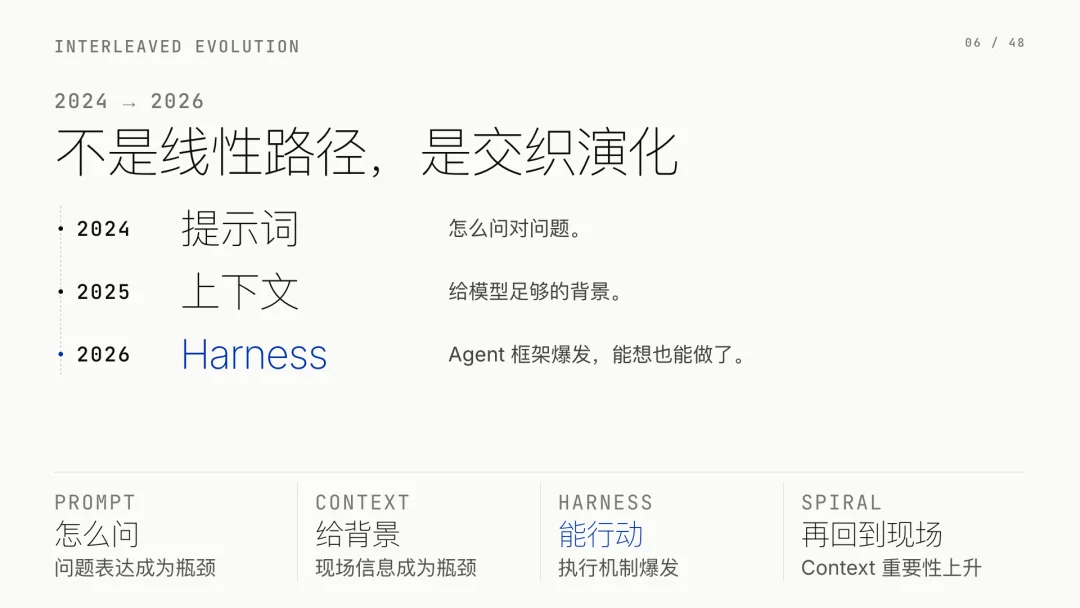
Over the years, the large model and agent industries have evolved in an intertwined way. Every time model capability and the harness get stronger, we come back to context. At first we focused on prompts, then on context, and then on the harness.
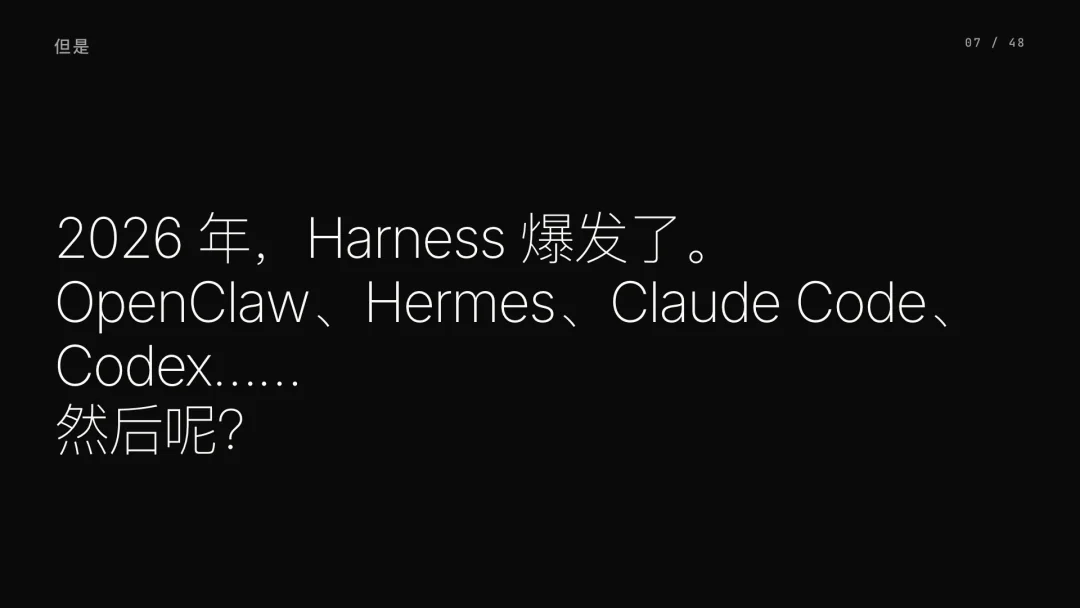
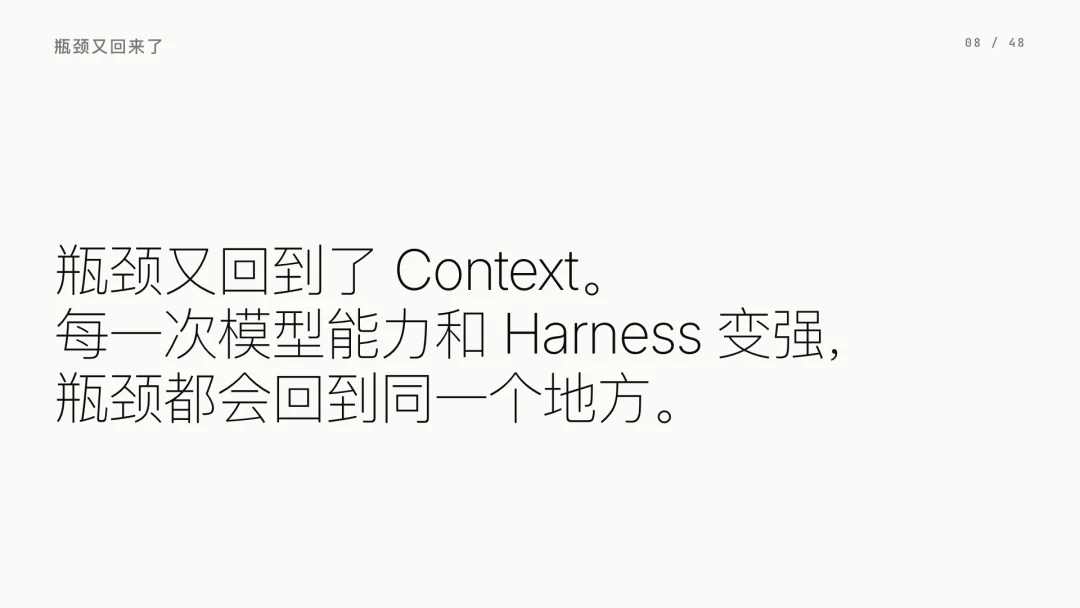
When model capability improved, we found that the context we provided to the model was insufficient and was actually limiting what the model could do. So we worked on the context problem. Once context improved, we strengthened the model’s ability to act by improving the harness. When the harness improved to a certain point, what limited the agent from getting stronger became context again.
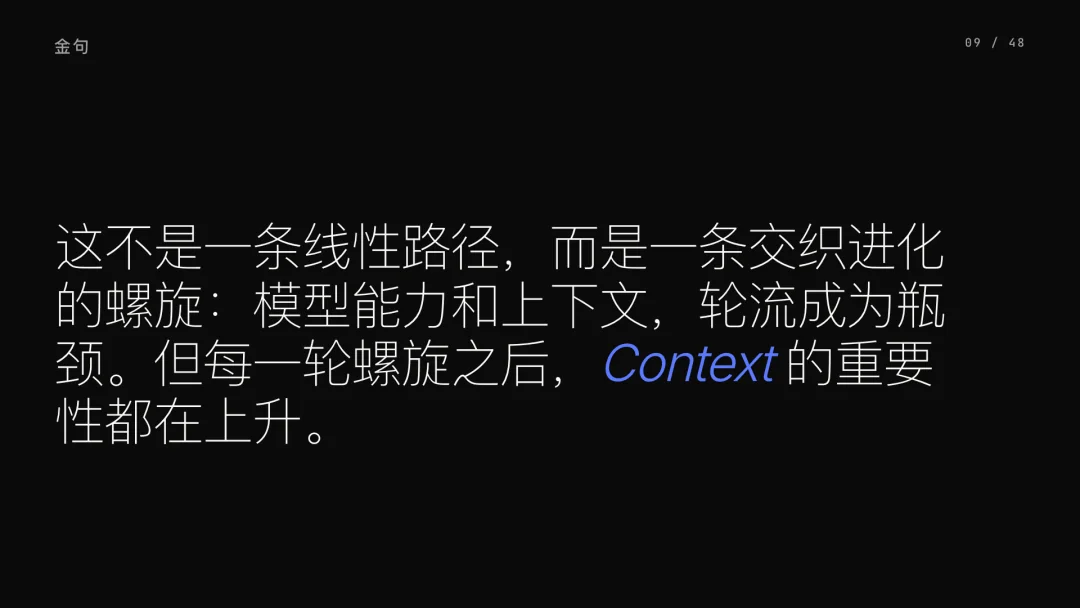
So improvements in model capability, harness capability, and context capability do not follow a linear path, but an intertwined spiral in which they rise in turn. Model capability and context take turns being the bottleneck, and after every turn of the spiral, context becomes more important.
We often say that models will eat many things: knowledge, information, patterns, best practices, and probabilities. At the same time, the models’ own capabilities are steadily improving, including executing tasks, calling tools, perceiving the environment, and running workflows.
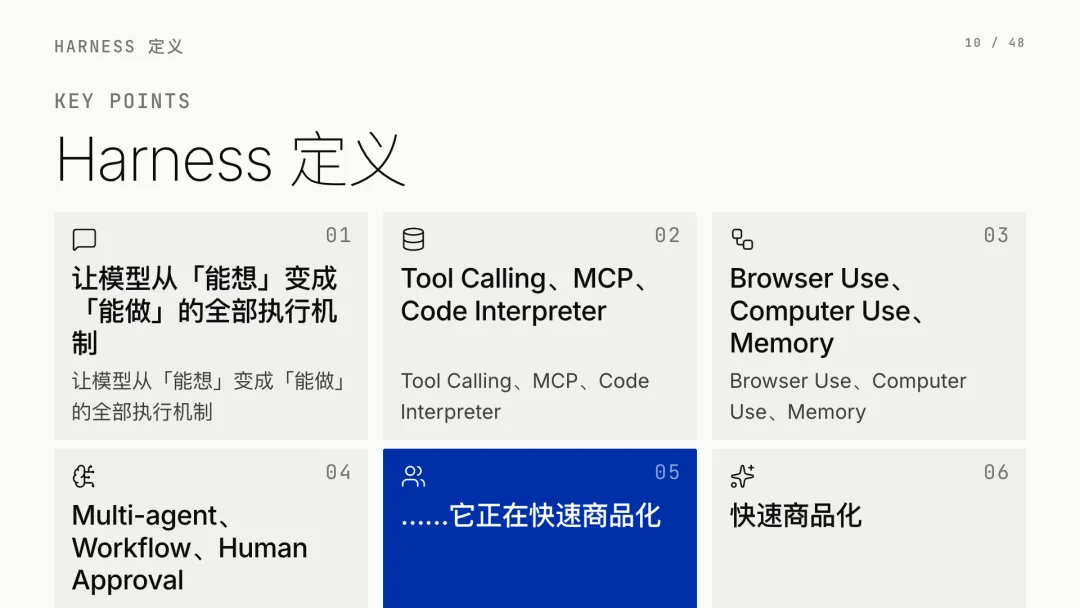
These capabilities originally belonged to the harness. But we are finding that they are gradually being integrated into models and becoming part of the models’ own capabilities. Whether OpenClaw, Hermes, or the various agent frameworks, their essential differences are shrinking, and execution-layer capabilities are slowly becoming commodities.
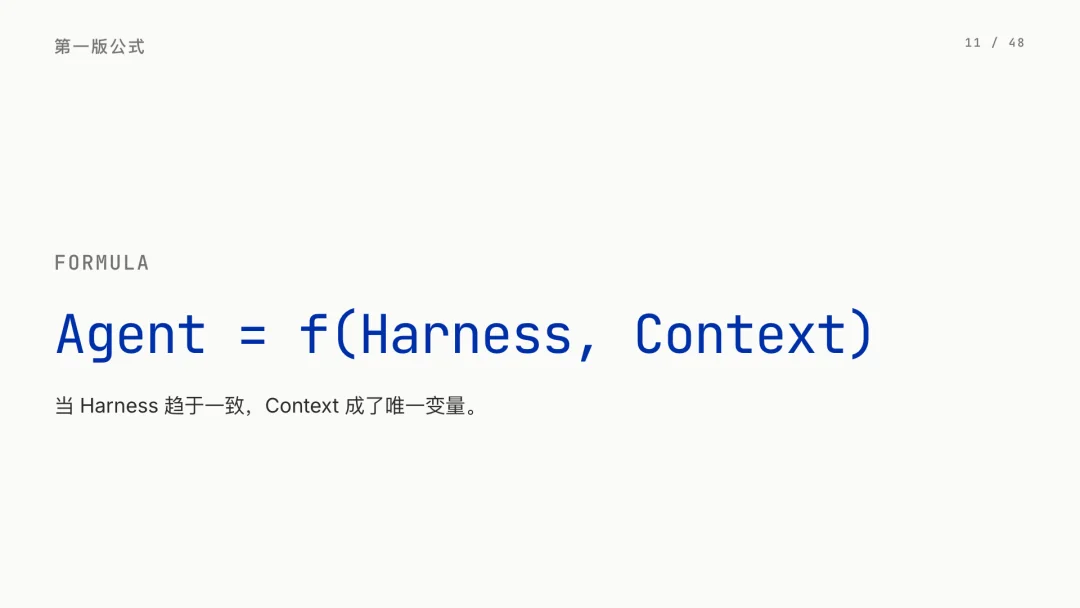
So let us look at the agent from this angle. The first version of the formula can be written as: the agent is a function of the harness and context. I said a lot about the harness and context earlier, but later I realized that the harness will gradually become part of model capability and converge. It is not a long-term stable variable, but a set of capabilities that keep improving and are eventually absorbed into the model.


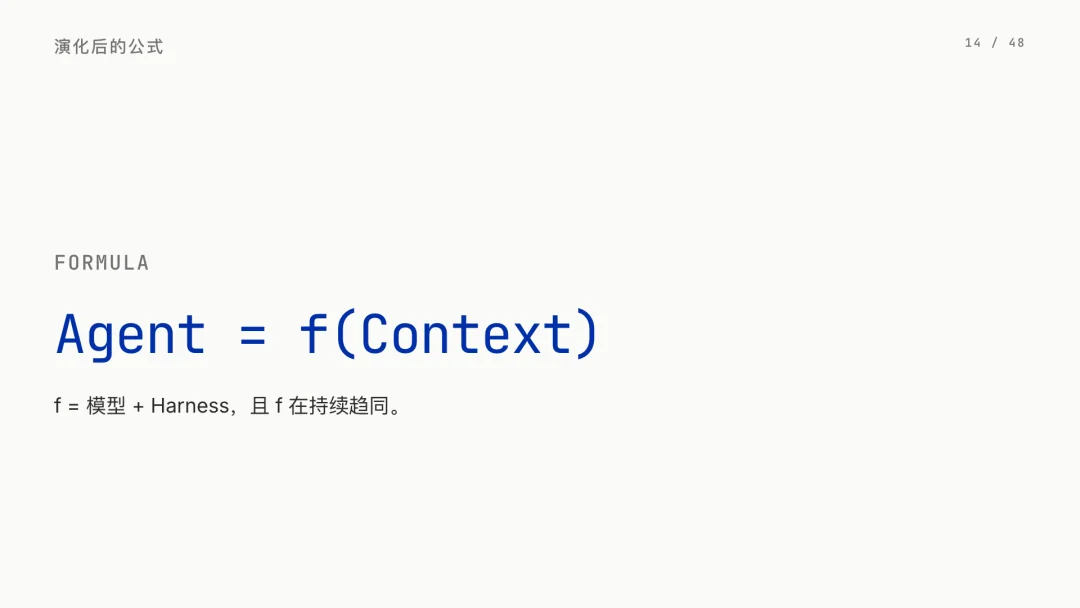
In other words, the harness is more like part of the function itself. Things that used to require external frameworks, such as calling tools, executing code, managing memory, and multi-step planning, are becoming native capabilities of the model. So what is an agent? It is more like a function of context. The model and the harness are essentially inside the function, and the variable that keeps changing and adapting is context.
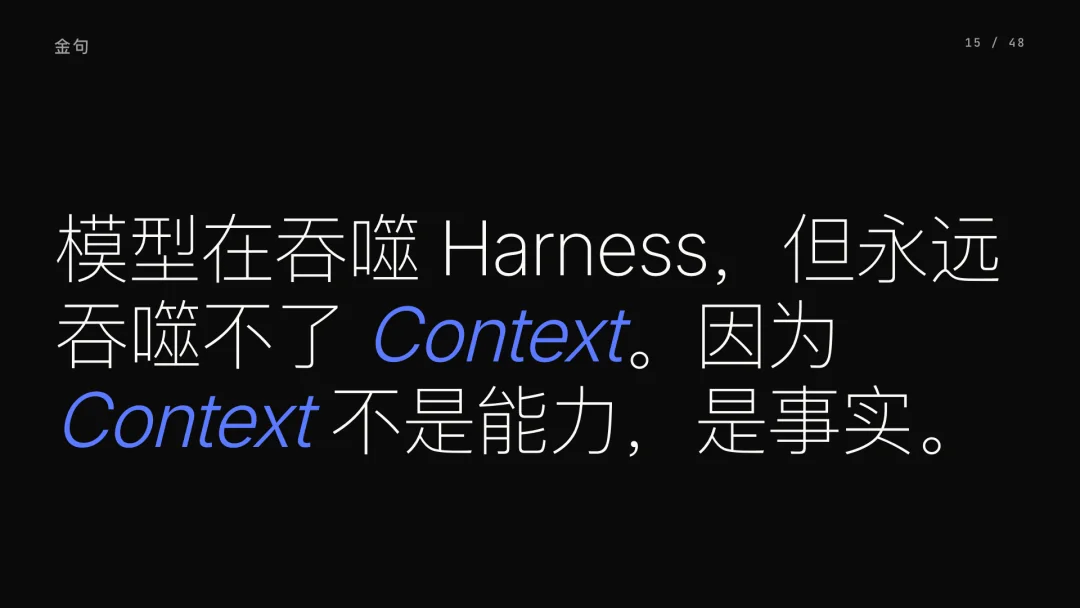
Models will keep devouring the harness and improving their own capabilities in the process. But models can never devour context, because context is not a capability; it is fact.
Why context is the decisive variable
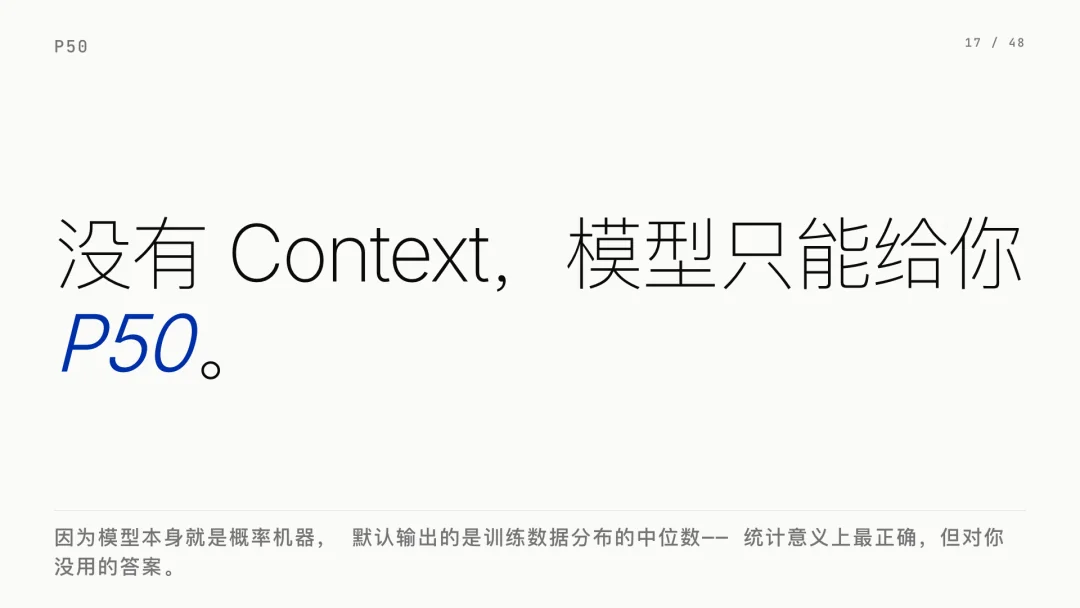
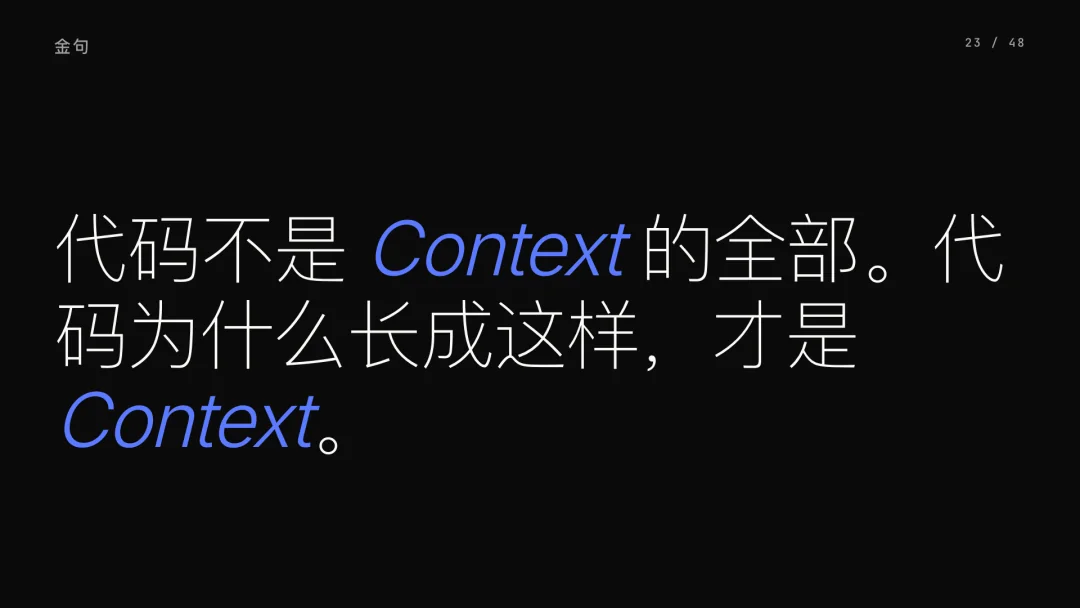
A model is a probability machine. Its default output tends to be the median of its training distribution, the part that is most correct in a statistical sense. Without context, when a model faces our problem, what it gives us is usually a P50 result.
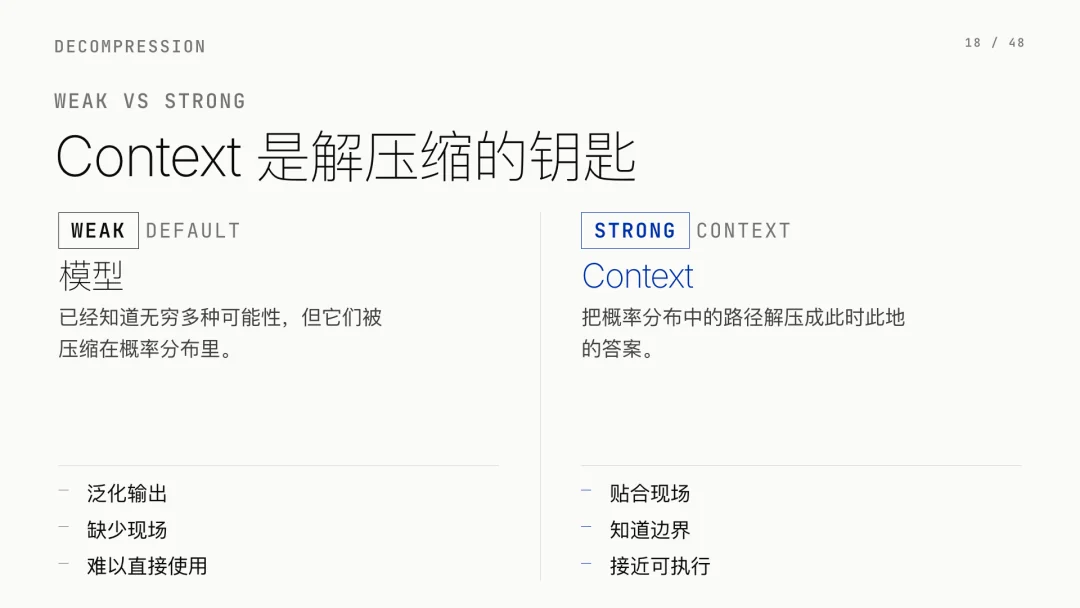
With context, things are different. Context is the key that decompresses the model’s capabilities. The model has compressed a vast number of possibilities into its probability distribution, and context can decompress one path into the answer for here and now.
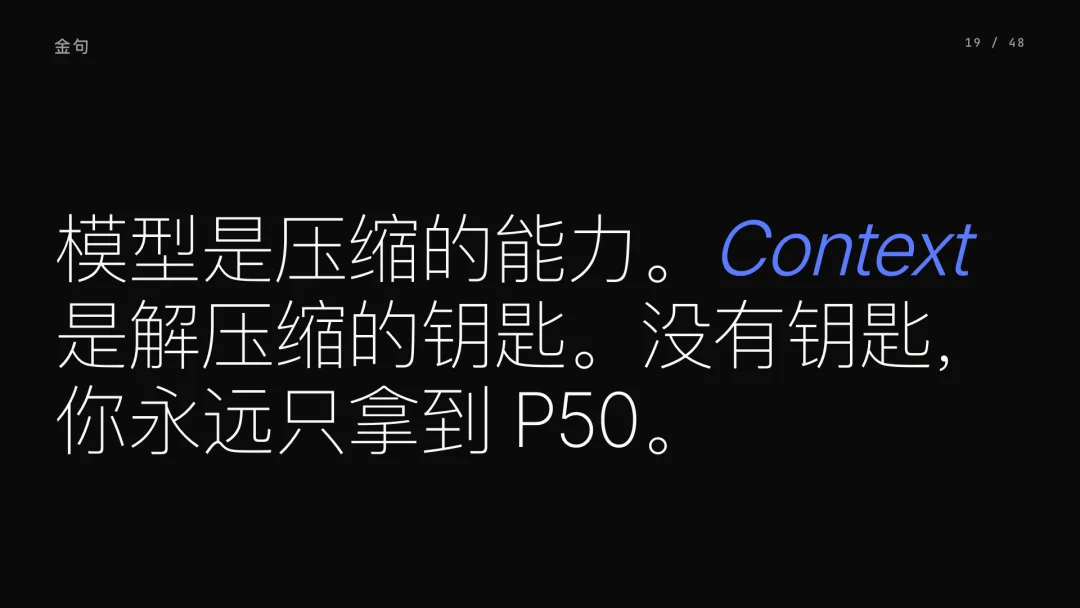

So what is context? It is the here and now; it is that key. Early prompts were usually just a sentence used to elicit the model’s capabilities, while context is an entire workplace.

Context reconstructs for the model the background and conditions in which a task takes place, enabling the agent to take more correct actions. Goals, background, history, constraints, materials, state, preferences, and success criteria all belong to context.
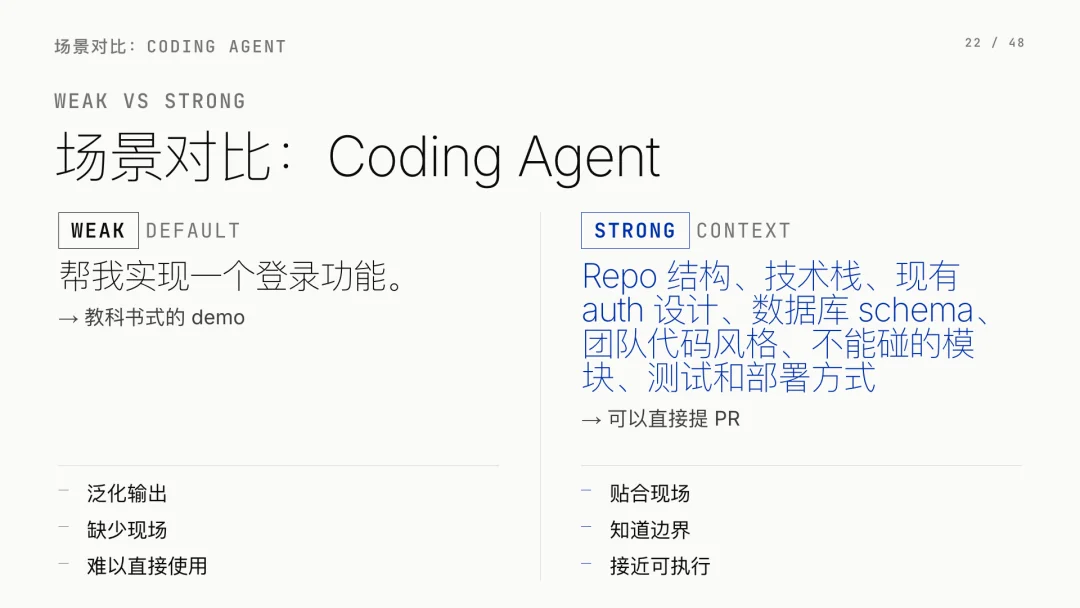
For example, if you just tell a model “implement a login feature for me,” it may give you a textbook example. But if you give a coding agent the project structure, tech stack, login design, database schema, team code style, modules it must not touch, and how testing and deployment work, the result will be completely different.
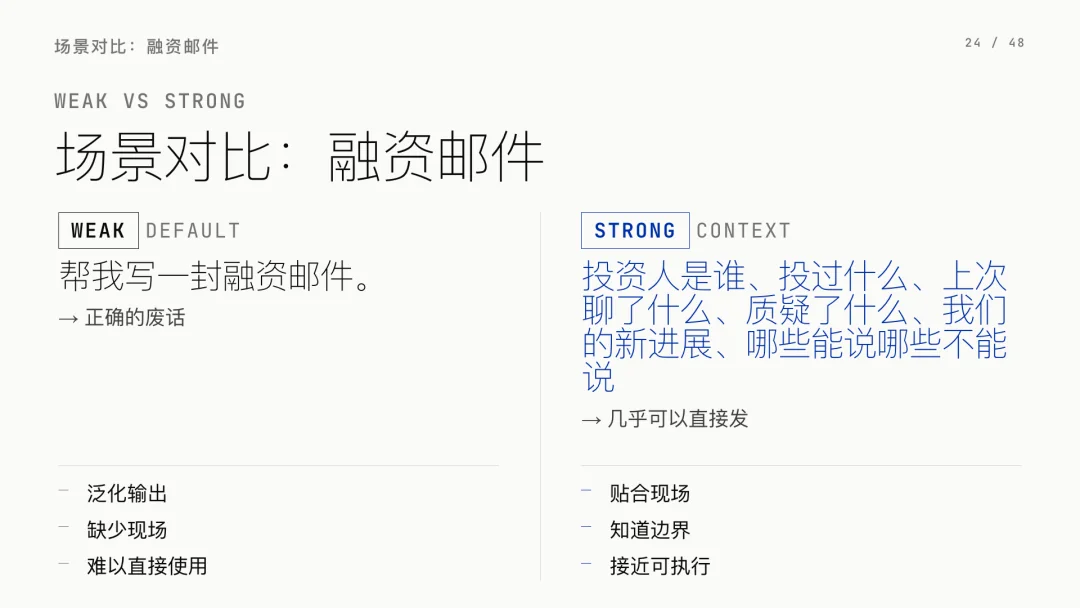
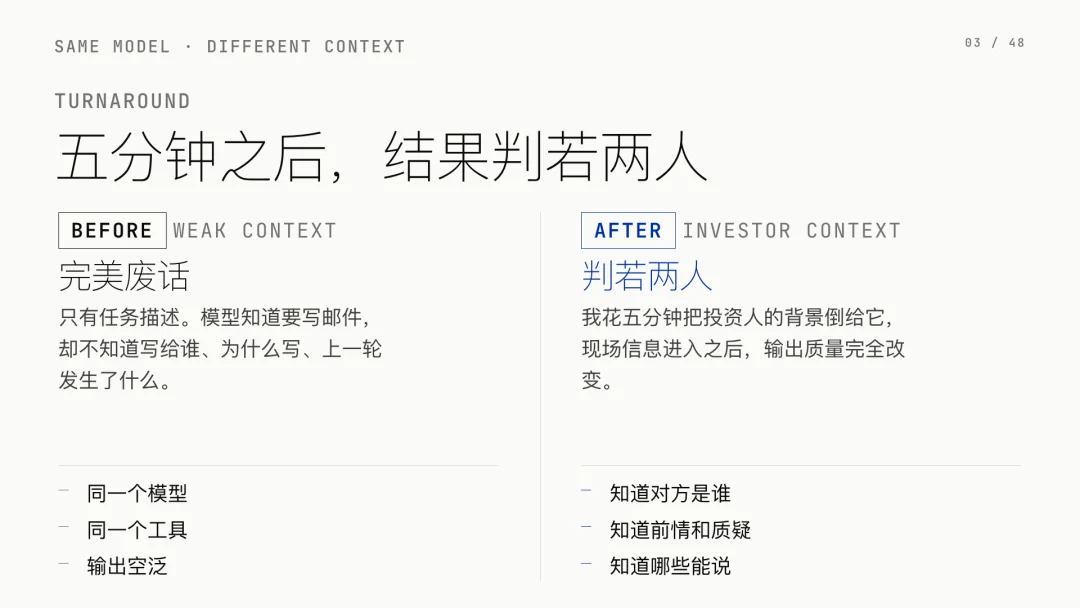
Back to the fundraising email example from earlier. If we give the agent sufficient background, it can also produce the result we actually want. What it gives us is then no longer a generic example, but complete output that meets real needs.
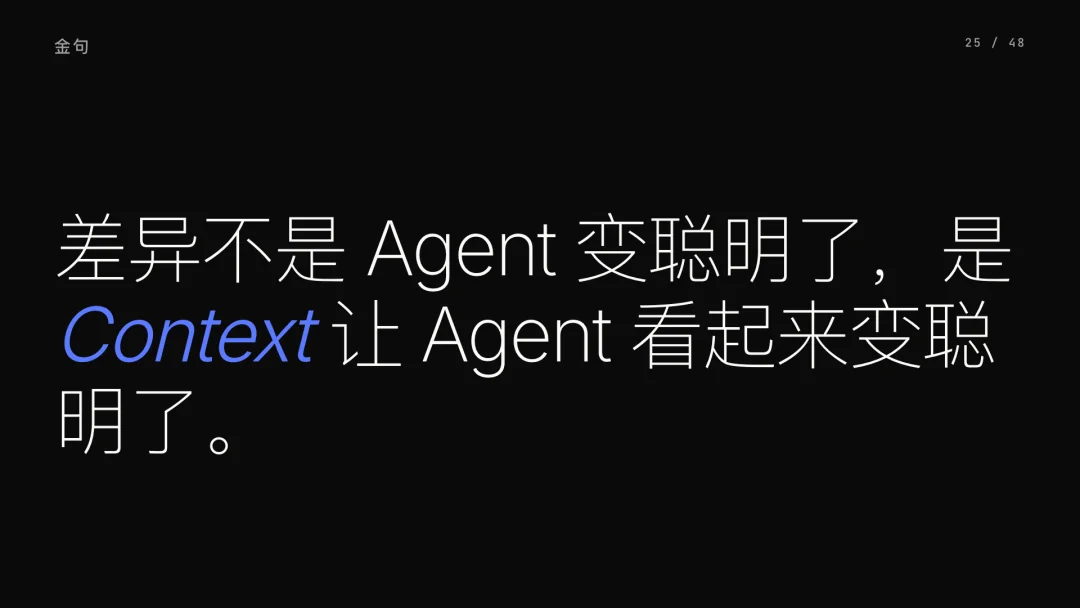
So the difference between your agent and mine does not necessarily come from the model itself. Even with the same model, agents can perform very differently. The difference often comes from how much different people invest in context. Provide different context, and you get a different agent.
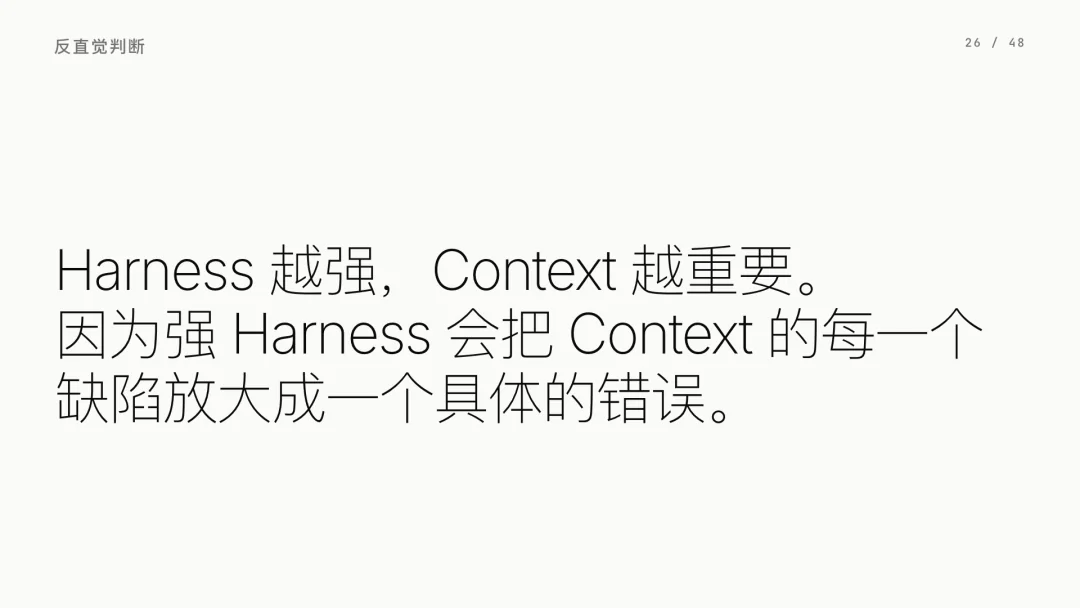
Moreover, the stronger the harness, the more important context becomes. Some think that once the harness gets stronger, context matters less because the system can handle everything automatically. In fact, a stronger harness more easily amplifies a small deviation in context into a concrete error.

So when we use the same model and the same agent framework, where is the real difference? The answer is still context.
Context is alive and grows with use

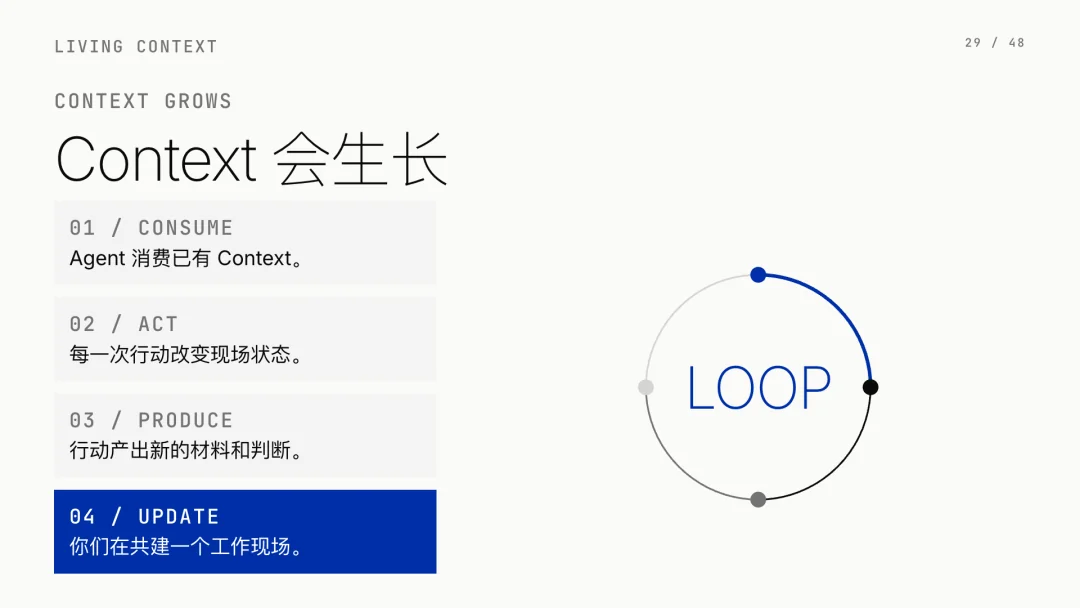
Context is not static. It is alive, it grows, and it has a timeline. When you use an agent, you are not only consuming context but also shaping it in return. Every action you take may change the context. What you and your agent maintain together over time is a constantly changing workplace, and that is context.
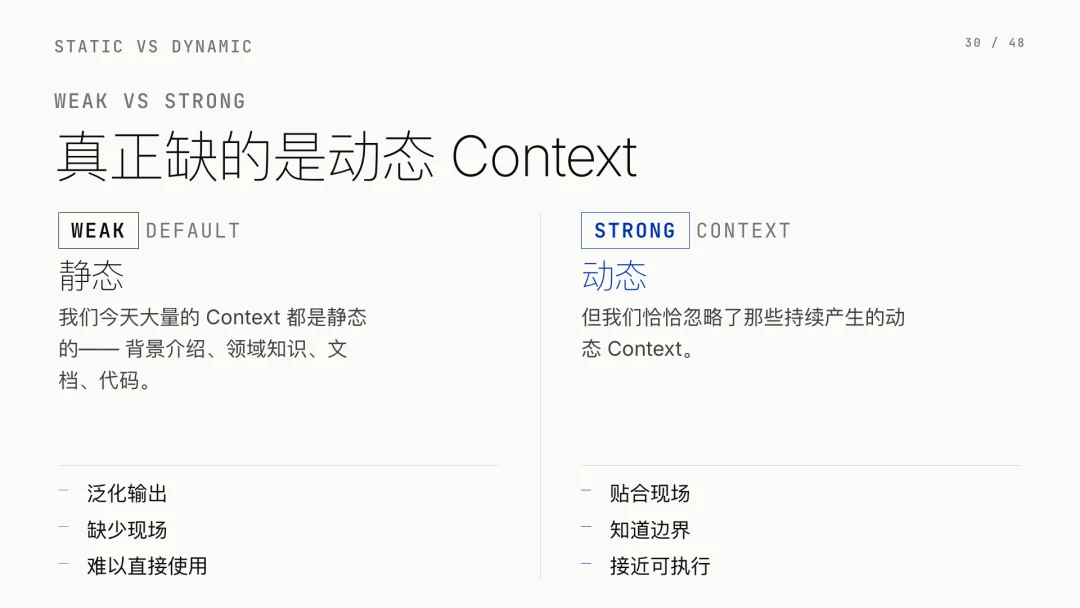
We are used to turning large amounts of static content into knowledge bases for agents, but many people overlook data that keeps changing. If this dynamic data is also provided to agents as context, their capabilities will grow further.
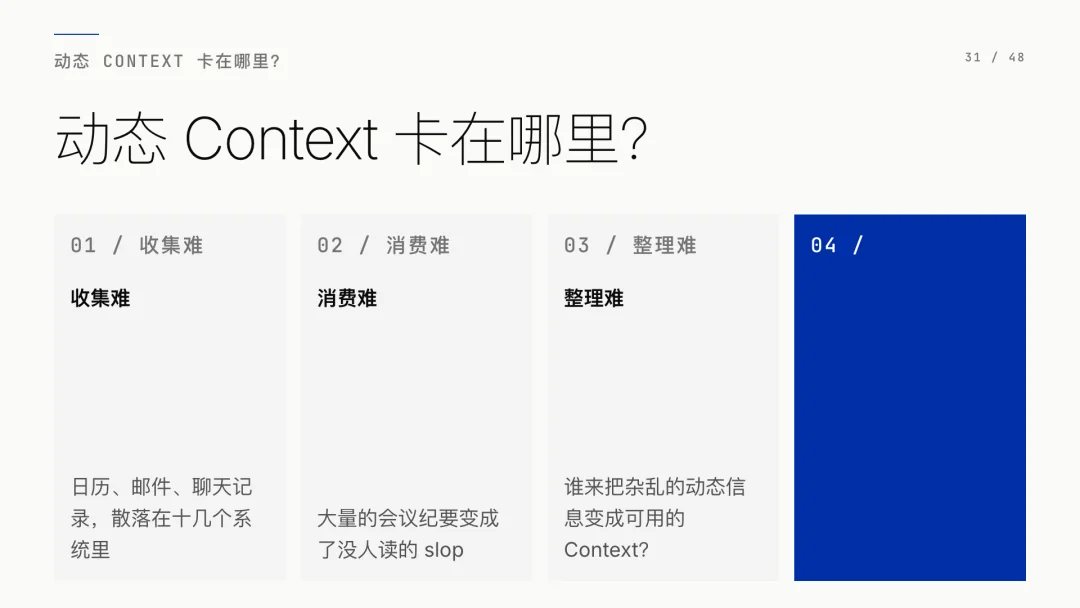
Why do so few people work on dynamic context? Because it really is hard: hard to collect, consume, and organize. Some LLM wiki products are already trying to solve this problem.
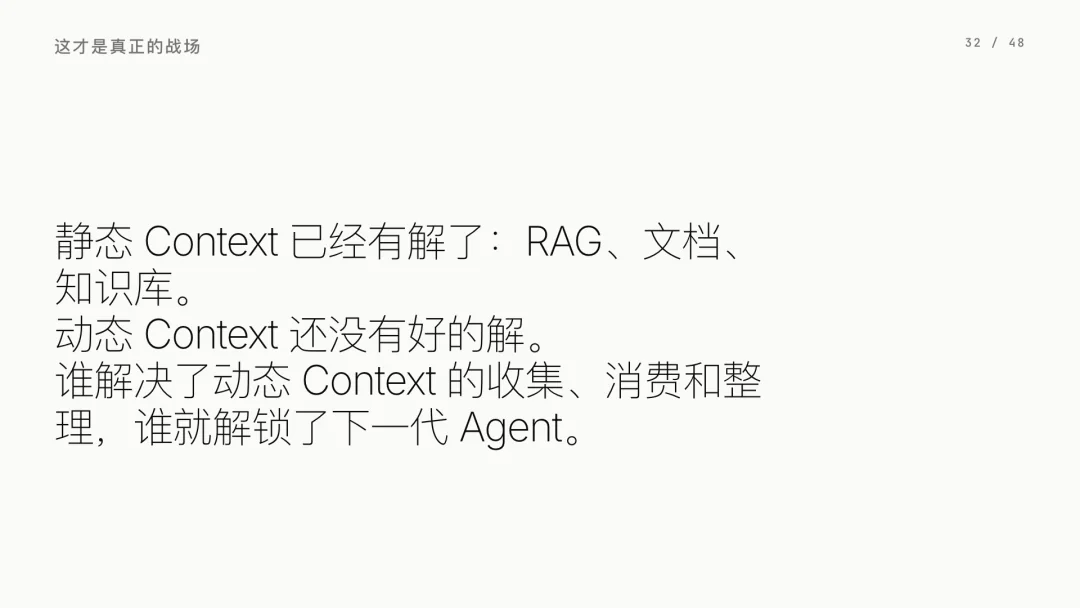
For agent founders and product developers, whoever can solve the collection, consumption, and organization of dynamic context may open up the opportunity of the next generation of agents.
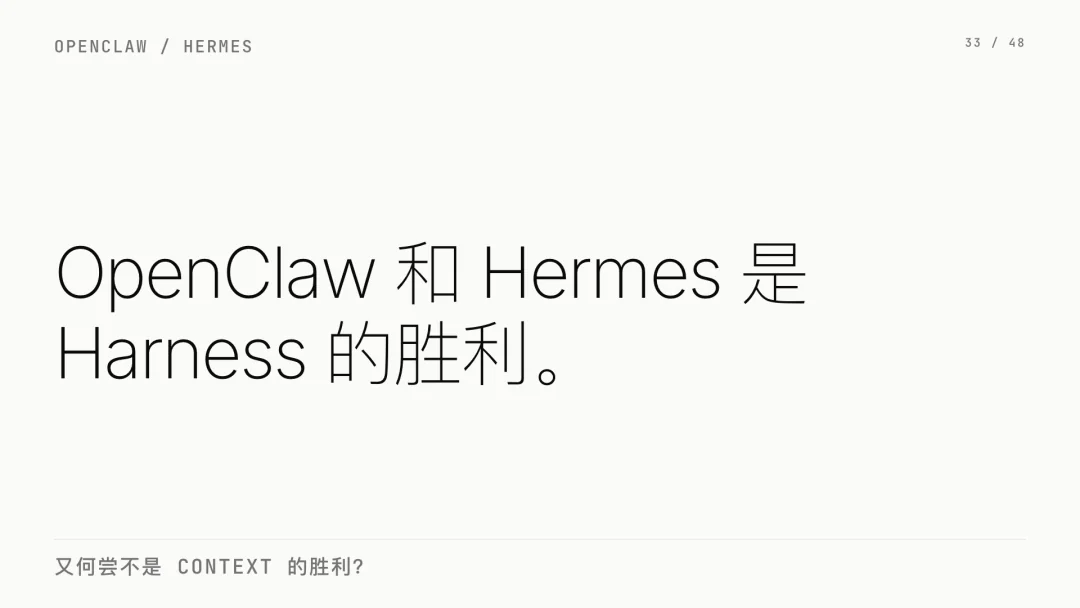
OpenClaw and Hermes are of course victories of the harness; many people agree on that. But from another angle, aren’t they also victories of context?
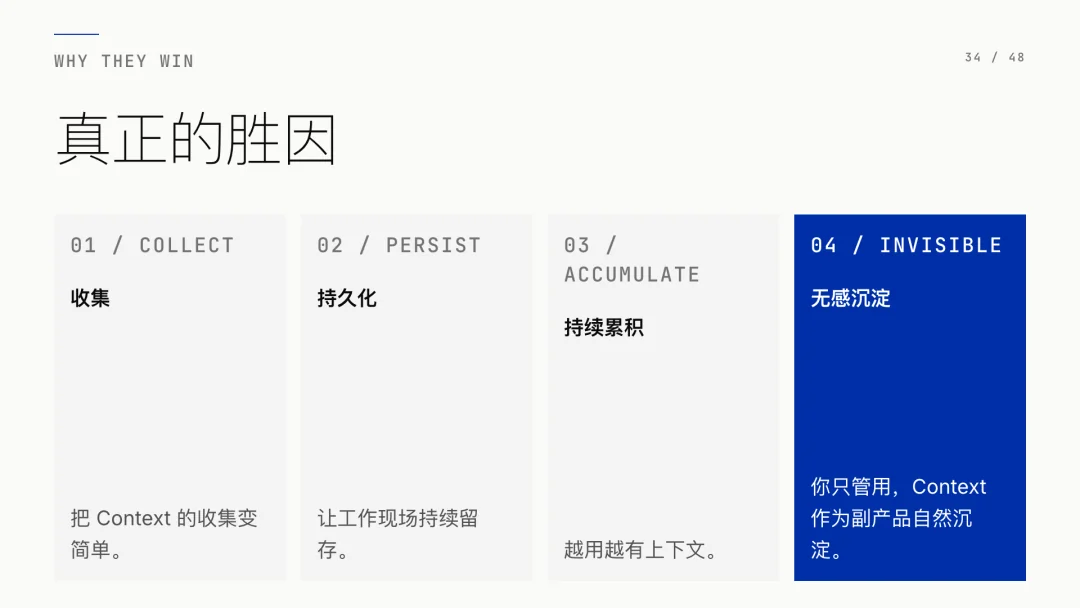
They lowered the barrier to collecting, persisting, and continuously accumulating context, letting context build up more naturally. Effortless accumulation of context is also an important reason these agent frameworks succeeded.
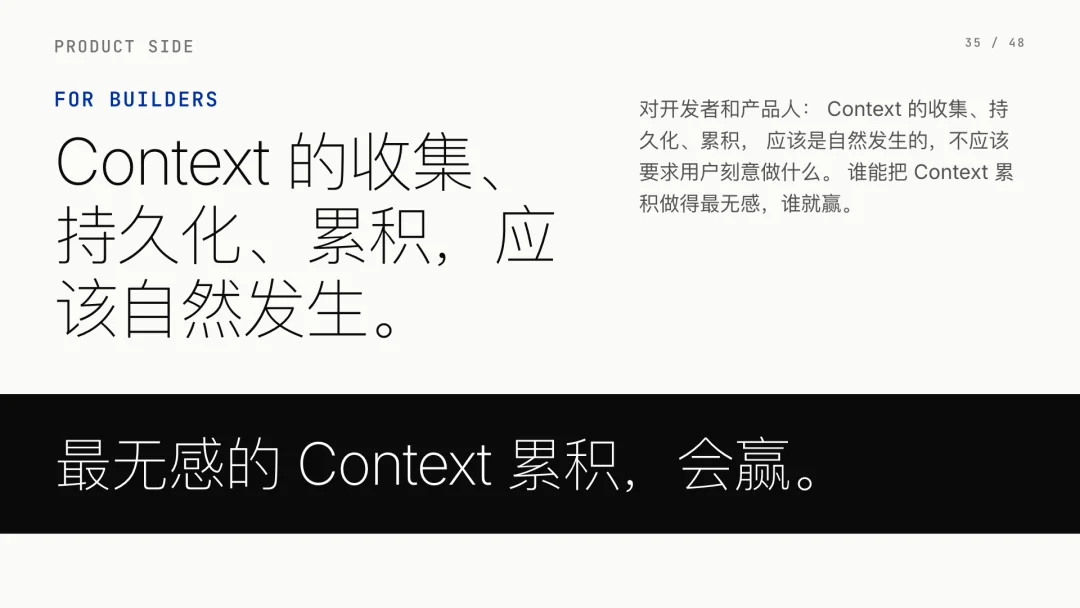
For developers and product people, collecting, persisting, and accumulating context should happen naturally, without requiring users to do anything deliberately. Whoever makes context accumulation the most effortless wins.

Think about it again: today we give input to agents mainly by typing. That in itself has a cost. When we type, we weigh every word and revise repeatedly, all of which adds to the burden of input. The ideal is to say whatever comes to mind, without any extra pressure of expression.

Only when expression itself can become input can agents obtain context more easily, and only then can we use agents more naturally. If a product requires users to prepare high-quality, organized, processed input, it is not yet an ideal agent product. A good agent product should make input effortless, so users don’t have to worry about input quality and the model analyzes and understands it on its own.
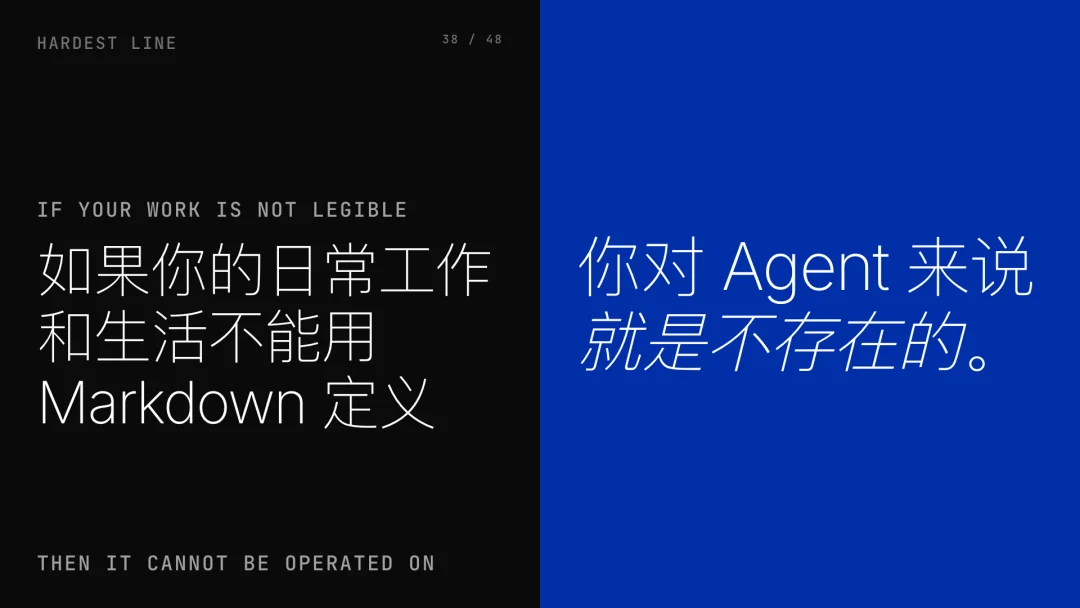
From another angle: how many people can describe themselves clearly in the digital world? If your daily work, personal materials, habits, and preferences cannot be expressed in text and structure, then to an agent you are a stranger. It does not know how to work with you better or how to serve you better.
The next war is a war over context

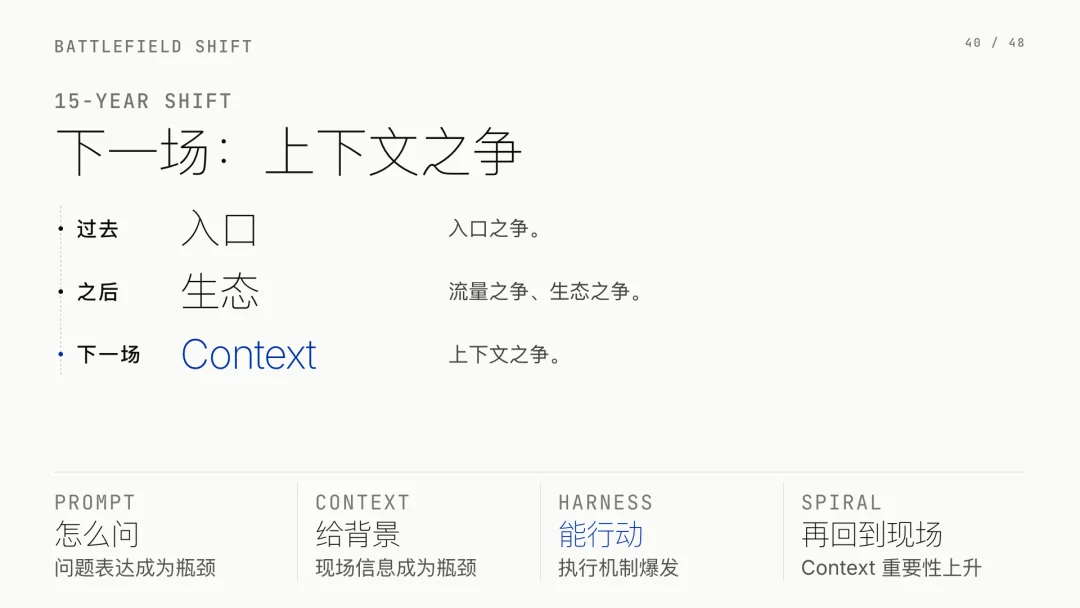
Today everyone is discussing the direction of agents, and startups and large companies alike are building them. But I believe future competition among agents will be not only a war over harnesses but, even more, a war over context. In the internet era, giants fought over entry points, traffic, and ecosystems; in the next stage, what they will really fight over is context. Whoever controls the context of users and enterprises will have a greater advantage.

To control the context of users and customers, products need to provide a good enough experience throughout the collection, organization, analysis, accumulation, and growth of context. Whoever owns the user’s context will have more initiative in the future. Context has another important property: it is not portable.
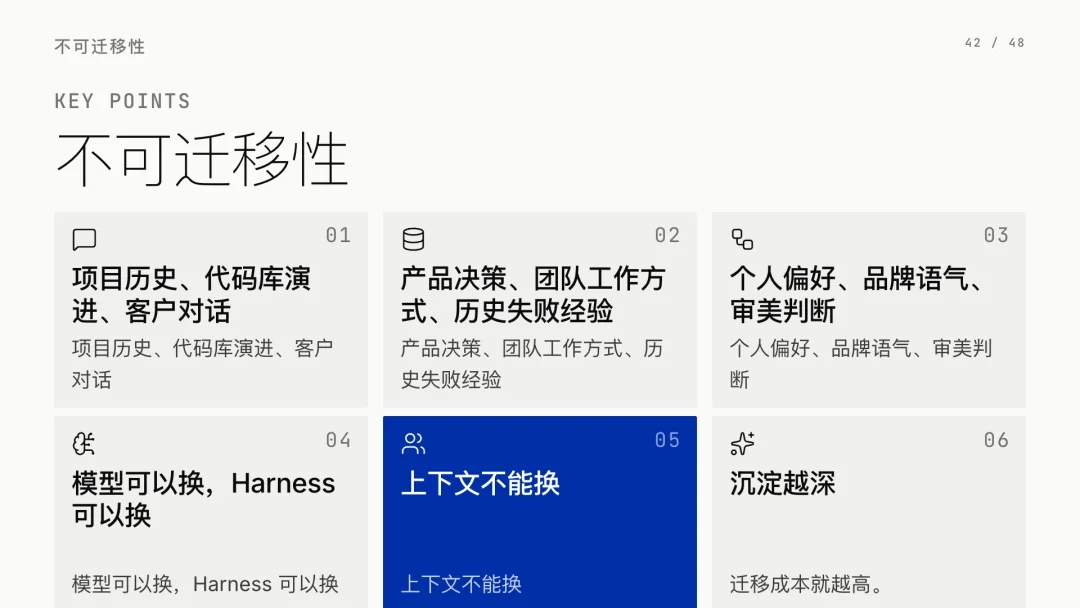
Agents can be swapped, and so can agent frameworks, but what cannot easily be replaced, and what keeps compounding, is context. Project history, the evolution of a codebase, customer conversations, product decisions, how a team works, personal preferences, and aesthetic judgment: the deeper these accumulate, the higher the cost of switching.
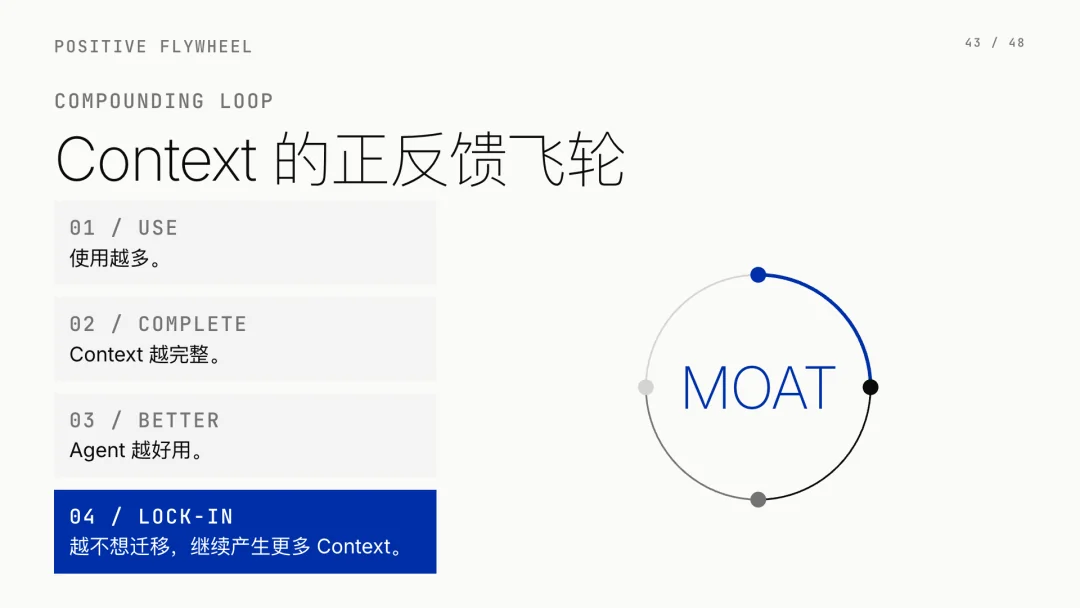
Context has its own positive feedback flywheel: the more you use a product, the more complete the context, and the more useful the agent becomes; the more useful the agent, the less users want to leave, and the more context they generate.
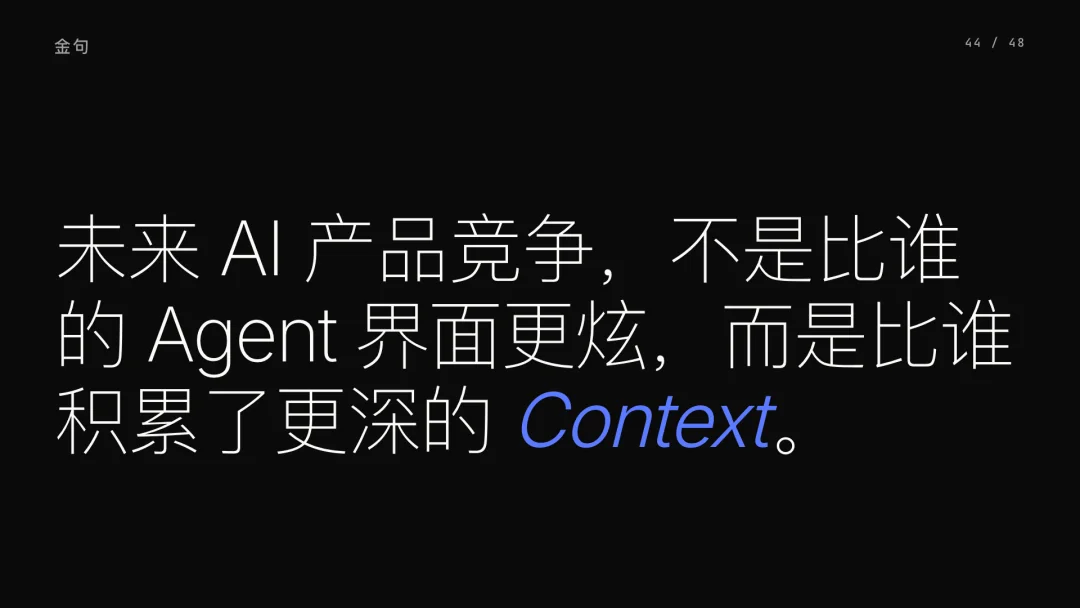
So future competition among agent products will not be about whose interface is flashier, but about who has accumulated deeper context.
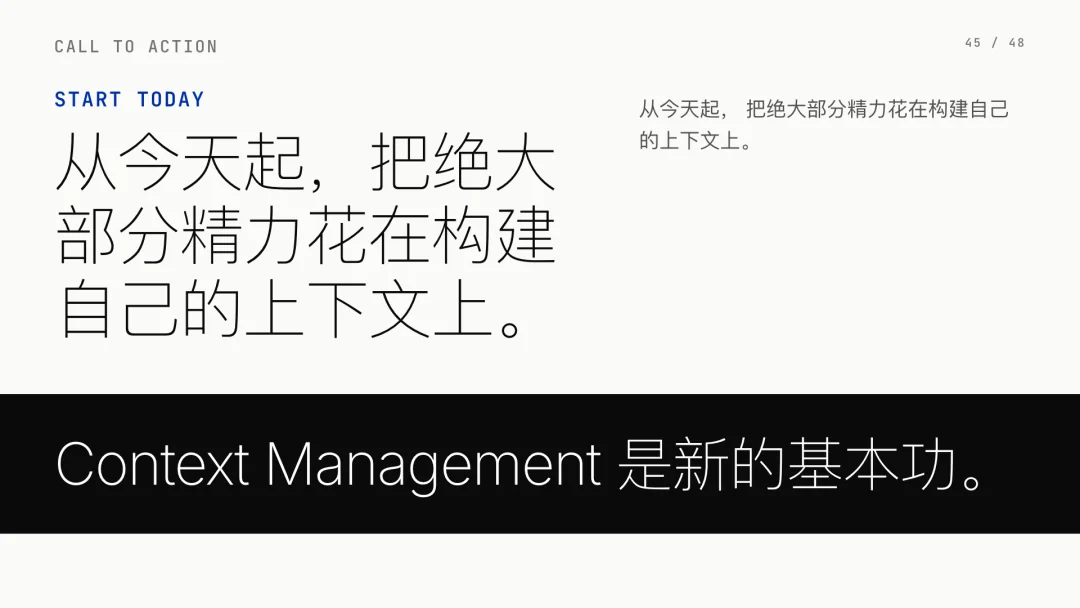
If you are an agent founder or developer, put your energy into helping users build context with a lower barrier. If you are an ordinary agent user, you should also put more energy into building your own context, the largest, most up-to-date, and most accurate reflection of your real situation.
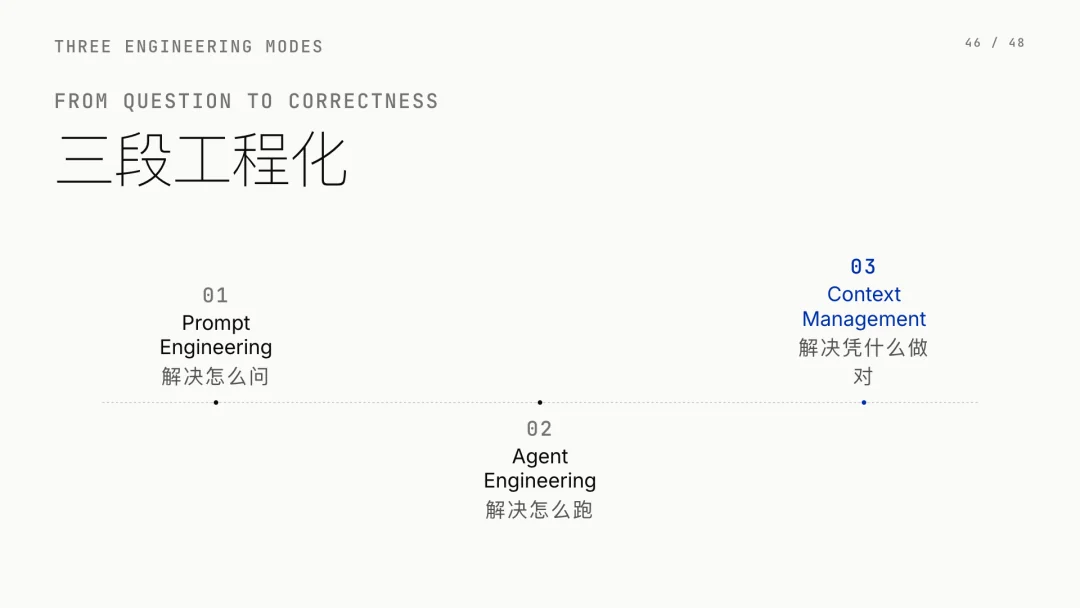
So context management will become a new skill and a basic competency for agent users. We have gone through prompt engineering, agent engineering, and context management, which address how to ask, how to run, and what makes it right. Finally, imagine this: what would happen if all of your context were laid out in front of your agent?

Compared with an agent that lacks context, an agent with enough context is more likely to develop emergent capabilities and provide you with more services. This is also the direction the agent industry needs to move in. After this discussion, the point I want to make is: context is the agent. Of course, this is only one way of looking at the question, from the perspective of context.
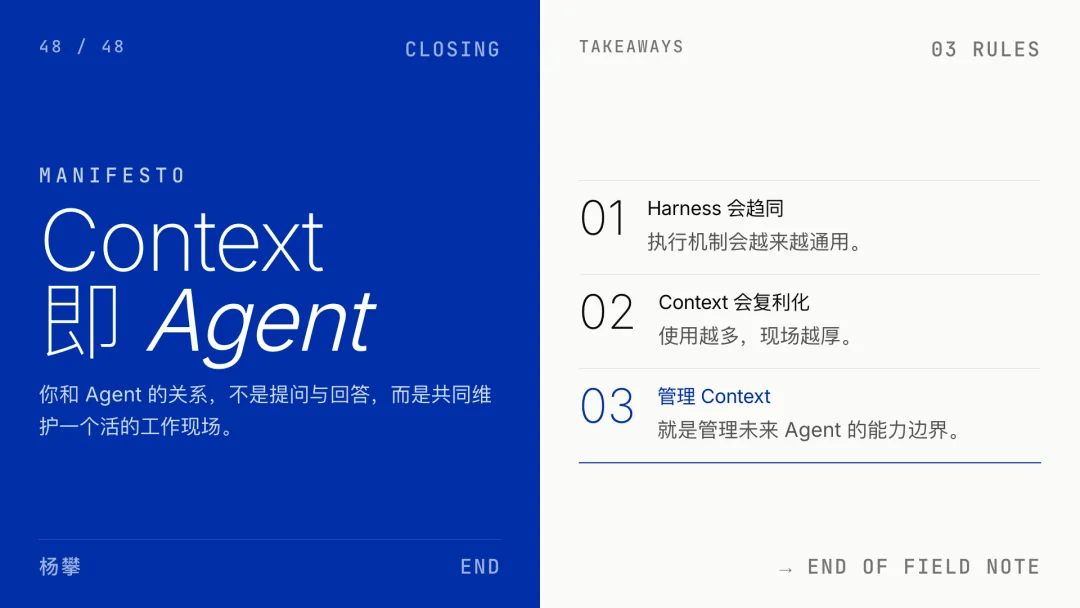
We cannot deny the enormous significance of agent frameworks and improved model capabilities in the overall path of development. But what I want to emphasize today is that context also has enormous value. In the future, model capabilities will keep improving and harnesses will converge more and more. Whoever has higher-quality, more complete, and more up-to-date context can build compounding returns and capture more value.
Whoever has better context captures more value.
Context is the agent. Manage context well, and the agent emerges naturally. From today on, put your energy into building your own context.
As model capabilities keep improving and harnesses converge more and more, whoever has higher-quality, more complete, and more up-to-date context can build compounding returns and capture more value.