Recently, a prolonged outage at a certain Chinese cloud provider set off heated discussion among my friends in tech. The topics were remarkably varied: some cared about the compensation plan, some about the physical robustness of the data centers, some about high-availability software architecture across multiple availability zones (AZs), and others about how the provider should handle crisis PR. But one of my friends overseas, Ma Gong (whose WeChat Official Account is worth following), had a very different focus. Out of habit, he searched for and checked the provider’s status page and found that, according to the chat screenshots at the time, for at least five hours after the incident began the status page disclosed nothing about it, and every service was still shown as available (no outage).
Let me take this opportunity to talk about what a status page is, and why a meaningful status page matters so much.
What is a status page?
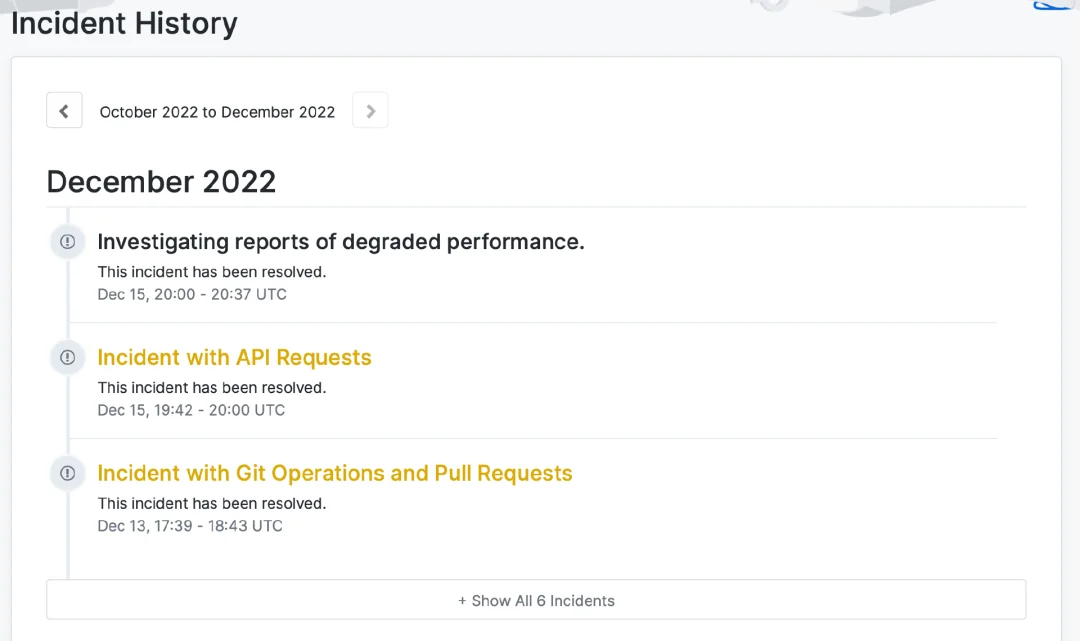
StatusPage.io is an infrastructure service launched in 2012 by Dogwood Labs Inc., a startup in Denver, Colorado. In one sentence: when your online business goes down, StatusPage lets you communicate with your customers and tell them the current state of the service and the progress of the fix. When the business is running normally, customers can also check whether the service is operating normally. They can also view the full history of the incidents the business has had and how each was handled.
In July 2016, the developer-tools giant Atlassian acquired StatusPage as part of its first round of acquisitions after going public, and renamed it Atlassian Statuspage.
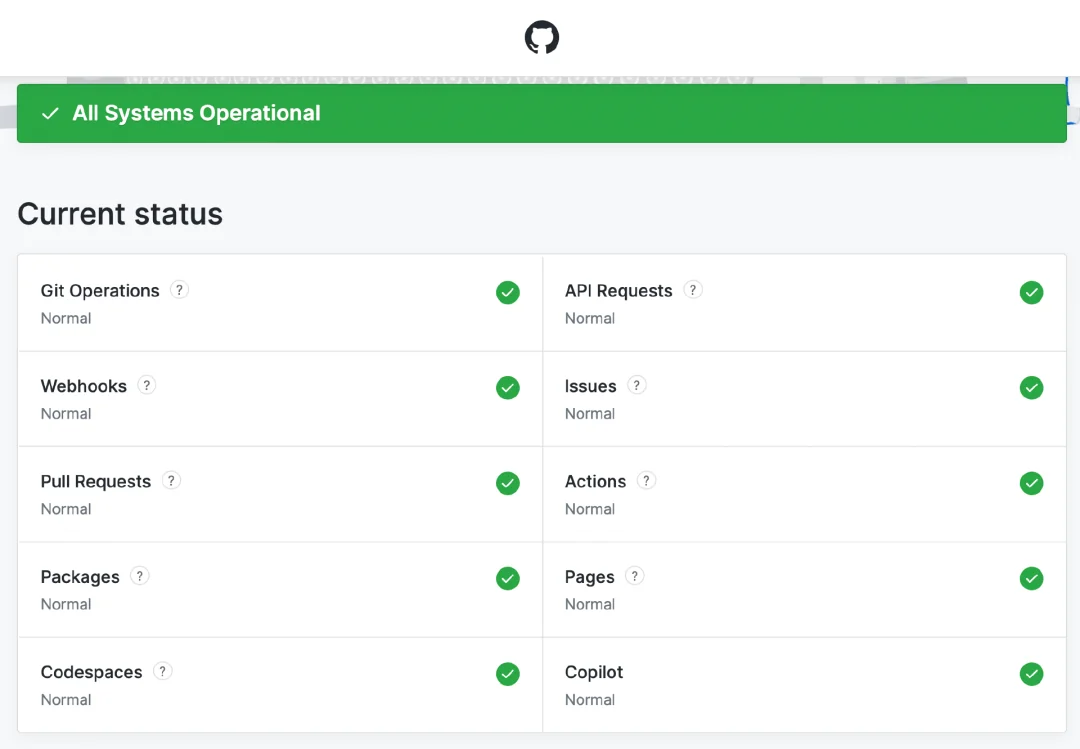
Let us take GitHub as an example of a typical status page:
According to Statuspage’s own description, the main value of the Statuspage service is:
“Reducing the cost for internet service providers of communicating with customers during downtime”
How does it reduce communication costs?
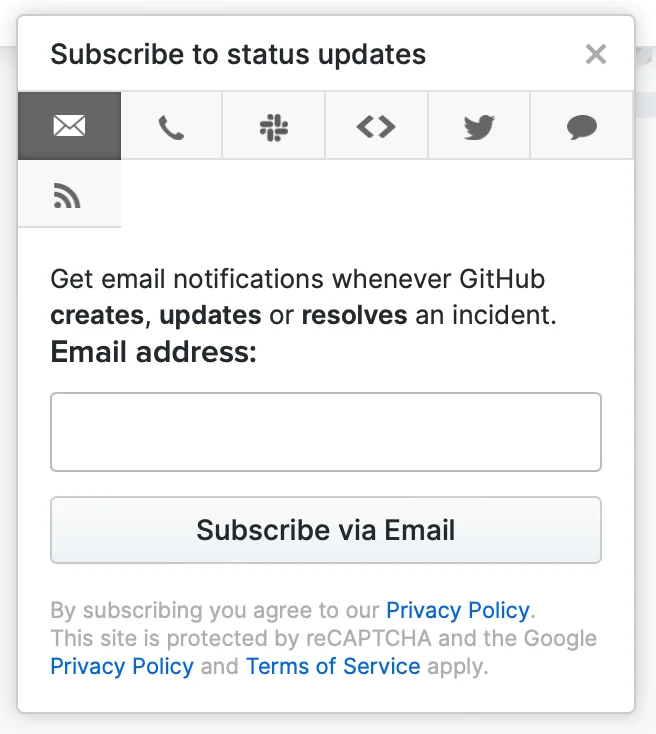
The first case: when an internet service provider goes down because of a failure or a DDoS attack, customers have no idea what is happening. The support line is flooded, customers keep asking when service will be restored, and account managers have to update each customer on the progress again and again. If you have a Statuspage service, customers receive notifications immediately through many channels, such as Email, SMS, Slack, Webhook, Twitter, the support site, and RSS. During recovery, customers can check the progress of the restoration and the details of the repair disclosed by the provider whenever they like, on their own.
The second case: when customers hit errors while debugging an interface or service, or while using a SaaS product, they often ask technical support and customer service: is your system available right now? Is something broken? If a Statuspage page shows the system’s service status, customers and developers can troubleshoot on their own; if everything on the provider’s side is normal, they start by analyzing and fixing things on their side. This greatly reduces the provider’s support costs.
Although a Statuspage service can reduce communication costs, that is only its most superficial value. The second value of Statuspage, and its core value, is:
“Building a relationship of trust with customers”
Look at the internet cloud providers, whether IaaS, PaaS, or SaaS: the question customers ask most often is, is your service stable? Is it available now? Is there an outage? If the provider answers that there is no outage, customers are often half convinced at best. In many cases customers notice failures faster and more often than the provider does. If the provider then has no public, transparent place that shows its service status, the impression it leaves is: unstable, opaque, and hiding something.
Sometimes, as a provider, publishing the failures you have encountered, your analysis and troubleshooting, and your recovery steps openly and transparently can greatly deepen customers’ trust. From the customer’s point of view, a supplier that grows and improves quickly as it develops, can clearly analyze and solve its own problems, and does not fall into the same hole twice is the supplier most worth trusting.
A survey of status pages at Chinese and international cloud services
I picked a few typical infrastructure providers in China and abroad to see how they provide status pages:
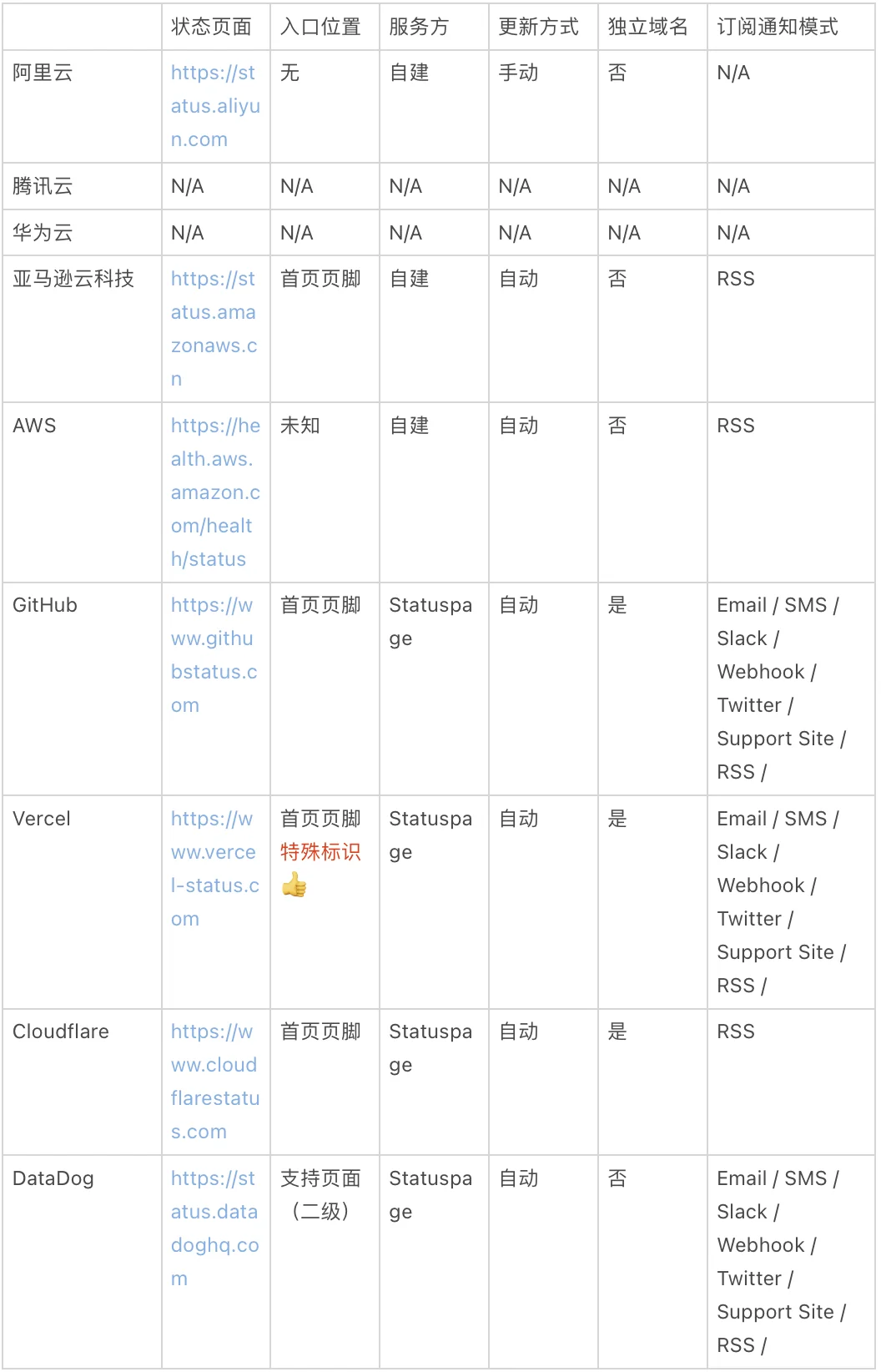
Note 1: Statuspage refers to statuspage.io, which was acquired by Atlassian in July 2016. Statuspage is the de facto industry standard for service status pages. I have to admire how global internet companies recognize and practice the industry’s best practices.
Note 2: Throughout this article, “Status Page” refers generally to status page services, “StatusPage” is the trademark of statuspage.io before the acquisition, and “Statuspage” is the trademark of Atlassian Statuspage.
As you can see, in China only Alibaba Cloud (the protagonist of the outage mentioned above) provides a status page, but I could not find an entry point to it in any prominent place. After the incident, it took a considerable time before the status was “manually” updated to show the outage. Nor is there any public channel people can subscribe to (the built-in alerting services of Chinese cloud providers are outside the scope of this article).
As for Tencent Cloud and Huawei Cloud, I searched with many combinations of Chinese and English keywords and found no such pages for either.
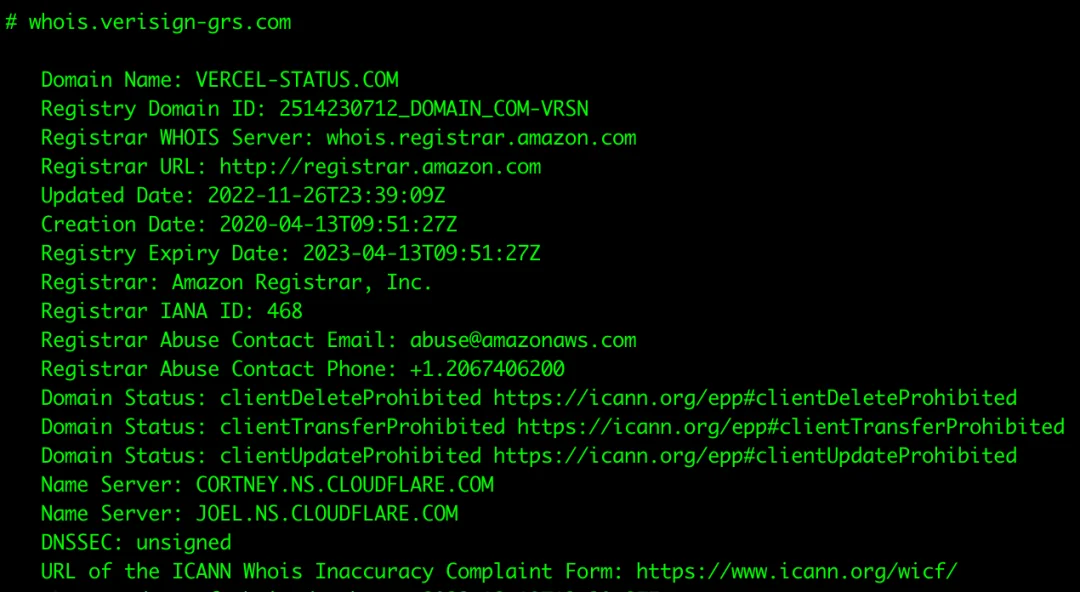
By contrast, GitHub and Vercel are exemplary in every respect. Vercel not only uses a separate domain; vercel-status.com even uses a different DNS name server provider from vercel.com.
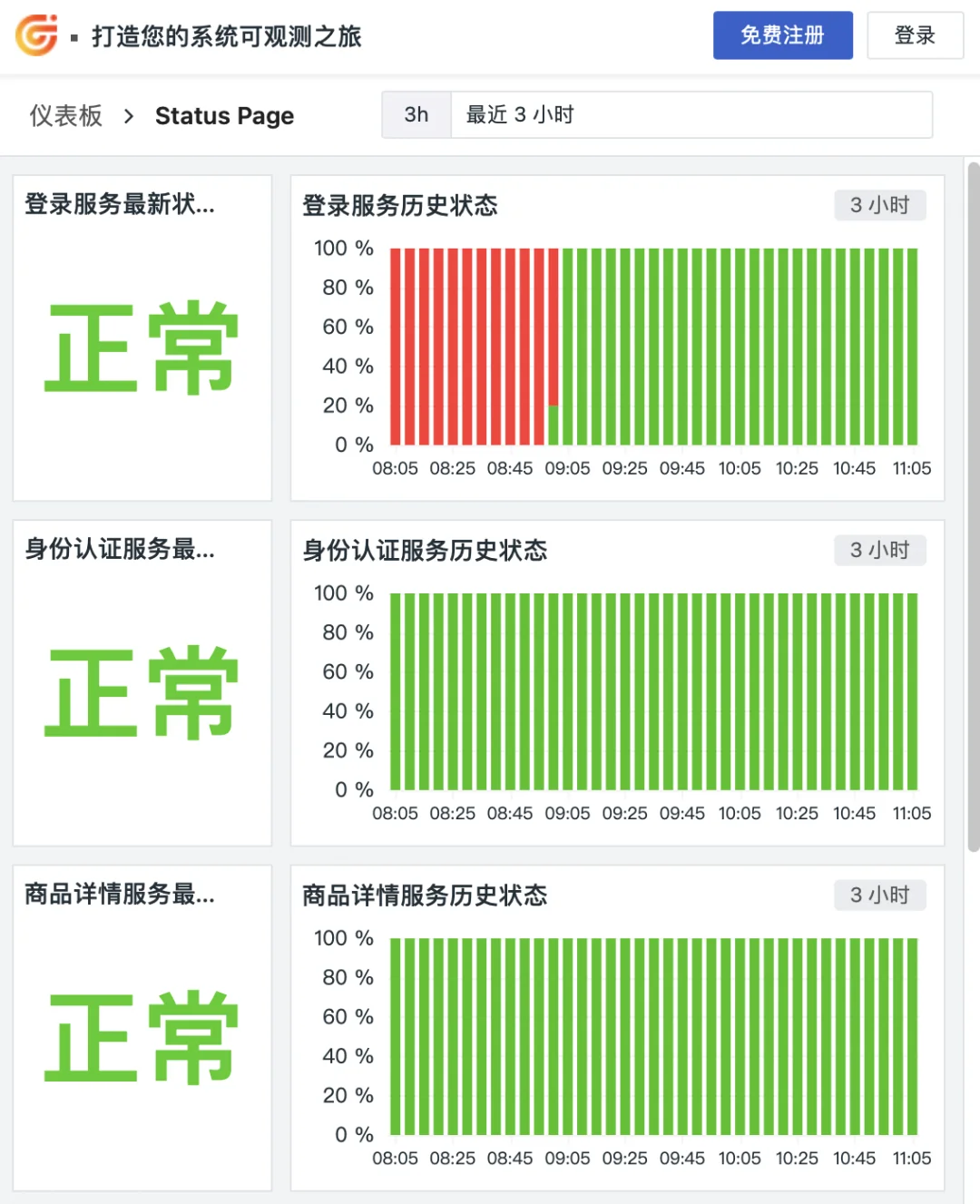
There are currently no mainstream third-party status page providers in China, but you can quickly build a status page with the products of observability providers such as Guance Cloud (guance.com), for example:
Why don’t Chinese providers take status pages seriously?
Reason one: don’t air your dirty laundry in public
When the service has a problem, fix it quietly. Why let the whole world know, and keep a history anyone can look up?
Reason two: leave room to maneuver
If the customer didn’t notice, it didn’t happen, and the external availability numbers look better.
Reason three: make up for the product with service
If product quality is poor, invest more in technical support and customer service. That way there is more communication with customers, and customer relationships improve too.
Reason four: they really can’t achieve high reliability yet
This may be the most helpless and also the most realistic reason. Under fierce competition, how many resources can each provider’s R&D and engineering teams invest, and how capable are they of making their services rock solid? If they could, wouldn’t showing a beautiful status page history be a badge of honor?
Why it matters
A status page is an honest mirror. It reflects the true engineering capability of the product and engineering teams, and the true service commitment of the provider. Only when a status page truly goes live does a provider begin to face its own quality problems bravely under external scrutiny.
Finally, I sincerely hope that Chinese companies will keep improving the basic quality of their products, pay more attention to developer experience, and respect the industry’s best practices.
So I invite every cloud provider, to push yourselves forward and gradually build international competitiveness, to raise a toast by launching a status page first.
Only then can our products and services truly go global.
CC: Xingdian of Alibaba Cloud, Zhang Ping’an of Huawei Cloud, Tang Daosheng of Tencent Cloud
A status page is simple. Deciding to make your status page public is hard!