Since writing “The Three Laws of IM Applications” (in Chinese) in 2022, I have been trying to build my own independent systems of logical thinking, connecting that knowledge with decisions and actions, and occasionally sharing it with other entrepreneurs.
Today I want to talk about one of those systems: the “China–US” difference in the digital world.
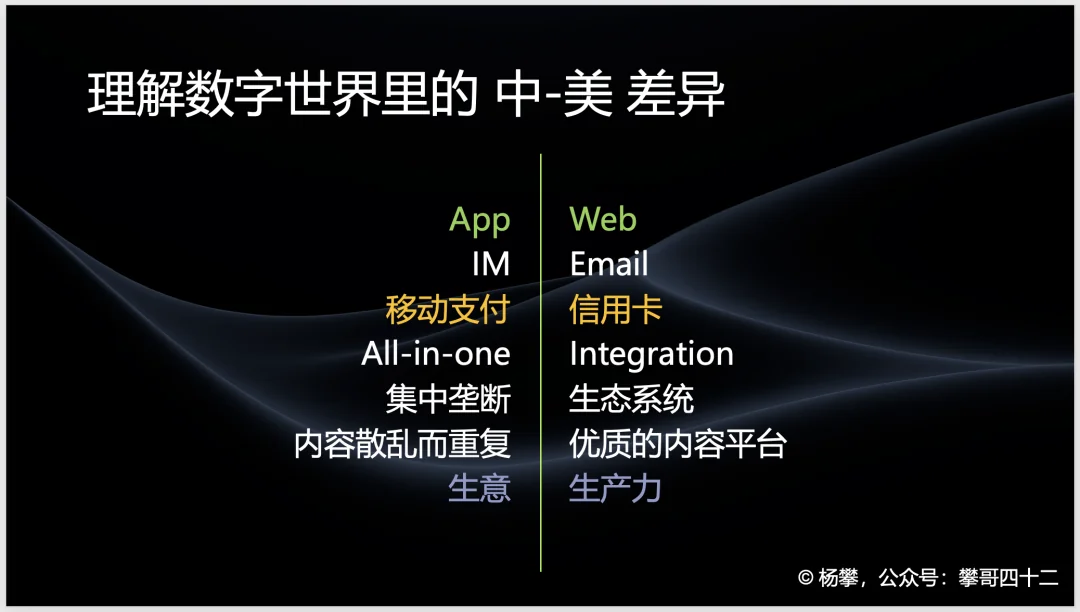
In what follows, I try to explain, by analyzing whether the Chinese and American application ecosystems are built on apps or on the web, why China and the US have diverged so much in the digital world, and why the gap keeps widening.
Before we begin, let me align on a few concepts. In this article:
- The mobile internet market means: smartphone users, mobile devices, apps
- The internet market means: PC/web users, PC/web devices, web = web pages
- In some contexts, the internet market includes the mobile internet market.
Now for the arguments:
China’s mobile internet leads the world; the US PC/web internet leads the world
China’s mobile internet (apps on smartphone operating systems such as iOS and Android) leads the world in business models and product forms. The US, the birthplace of both the internet and the mobile internet, has taken the business models and product forms of the PC/web internet (the web on desktop operating systems such as Windows and macOS) almost to perfection.
Although the infrastructure of the mobile internet era, iOS and the App Store, Android and the Google Play Store, was invented in the US, China took the products and business models of the mobile internet’s application layer to their extreme in practice.
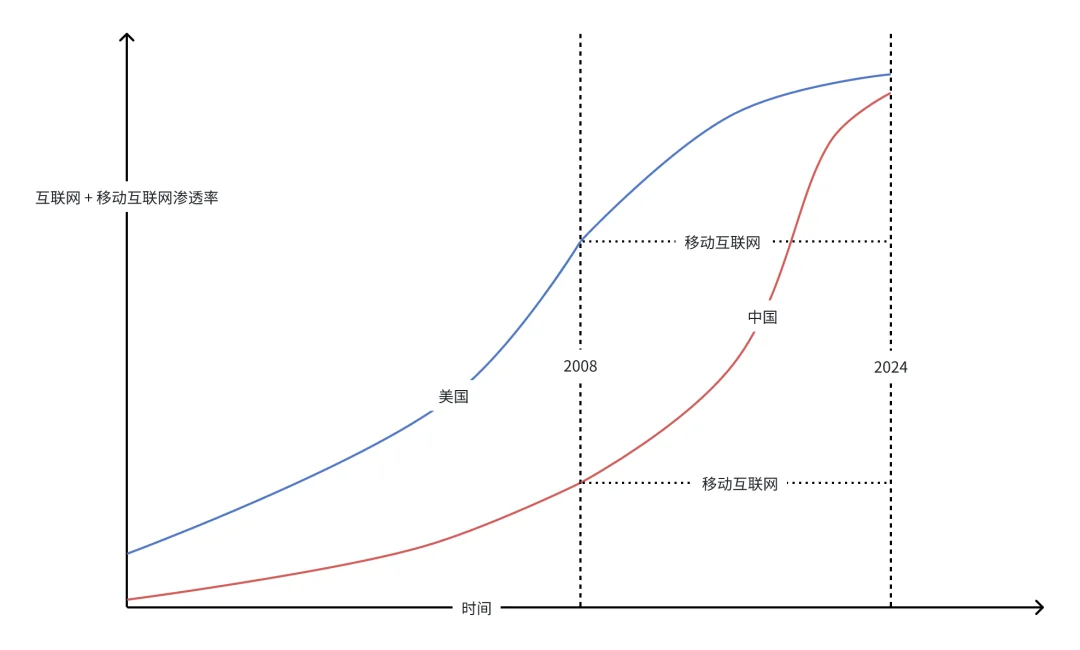
As smartphones spread around the world, the Chinese internet was the biggest beneficiary. China’s mobile internet users grew explosively along with smartphone adoption, and within just a few years China’s combined internet and mobile internet penetration reached the same starting line as the US. This was the biggest windfall in the entire history of China’s internet. China’s PC/web internet market, meanwhile, was smothered in its cradle before it could grow up.
In every market, OTT is inevitable
OTT (over the top) refers to internet companies bypassing carriers to provide video and data services directly, independent of the physical network, emphasizing that the service is independent of the network. The term comes from the “over-the-top pass” in basketball, meaning internet companies go around the carriers to serve users directly.
Applying the OTT concept to the internet: before China’s PC/web internet penetration had grown high enough, the mobile internet arrived, and it arrived with tremendous force. Because the mobile internet costs less to reach users, or costs users less to use, its penetration in China naturally rose rapidly, which directly suppressed further growth in China’s PC/web internet penetration.
The mobile internet market has permanently taken the mainstream of China’s user market, and the trend is irreversible.
Another classic OTT is mobile payment in China. Before mobile payment became widespread in China, credit card adoption had been rising steadily. When mobile payment suddenly appeared, credit card adoption and usage stalled, then fell to a very small range. Credit cards thus permanently exited the stage of China’s payment market, and the trend is irreversible.
And another OTT: as China’s internet market grew, while email was still slowly spreading among white-collar workers, QQ, an IM product, rapidly became the dominant force of China’s internet era. Email died before it could succeed and left the mainstream of internet communication in China. In the mobile internet era, WeChat took over QQ’s market dominance (see the third law and its seventh corollary in “The Three Laws of IM Applications”). Email usage, for its part, did not rise steadily alongside IM; instead it was squeezed continuously by IM and enterprise IM products and was finally reduced to a tool for “keeping a record.” This trend is also irreversible.
The two sides of the time machine theory
The time machine theory: making full use of uneven development across industries by starting a business in a developed market such as the US, then entering Japan when the time is right, then China, and finally India and other markets, as if riding a time machine through the past and the future. Time machine thinking originally meant making full use of the uneven development of different countries and industries to bring advanced technologies and ideas to less developed regions.
The time machine theory has two sides. Used correctly, it lets us understand markets and discover business opportunities. But its greatest fallacy is this: different countries and regions have different histories, cultures, and stages of development, and if you rigidly follow the original playbook when executing locally, you will not succeed.
The difficult decade of China’s B2B market was caused by exactly this kind of misapplication of the time machine theory. I will discuss it in detail in a separate article.
China’s internet economy is built on apps; the US internet economy is built on the web
China’s internet economy is built largely on the mobile internet, and China’s mobile internet mainly serves consumers. It revolves around consumer business: payments, O2O, live streaming, e-commerce, games, and social networking are all consumer battlegrounds.
As for the foundation of the US internet, according to various market data, the market value and investment in B2B and B2C in the US are roughly split 50/50, while in China the split is 10/90 or even more lopsided. And look at the service interfaces of US B2B companies: the vast majority are built on the PC/web. In the US consumer market, although mobile device usage has overtaken PC usage in recent years, the ratio of PC to mobile usage is still within a factor of two. In the Chinese market, the gap between PC and mobile should be an order of magnitude.
The web is far more open than apps
The web internet is built on two great technologies, HTML and HTTP. Over decades of development, every web page has been linked to several others through the hyperlinks embedded in it. The entire web internet forms an information network with infinite nodes.
Search engines help users explore and roam this web world. A search engine lives up to its name: it is the “engine,” the “motor,” of the whole internet world. Google distributes traffic across the entire web according to a clear set of rules (PageRank), and the practice of following those traffic distribution rules is SEO. Search engines greedily seek the high-quality content users need and present it to them.
And so a classic “virtuous cycle” began: search engines need high-quality content; to be indexed more easily by search engines, large amounts of high-quality content were created; and in the end, the content of the whole web became better and better.
By the way, because Baidu has not played the role of a real search engine well, SEO on the Chinese web is of little use. As a result, the Chinese-language web is flooded with junk content: UGC is all paid posters, and PGC is all advertising.
On smartphone operating systems, the channels connecting apps are extremely limited. Android and iOS handle only app distribution, not connecting content, and this design inherently builds high walls between apps. In the Chinese market, this closed nature of apps gave the app giants maximum technical support for building walled gardens (if I don’t let you leave, you can’t leave).
The internet built around HTML and HTTP is the greatest invention in human history, and apps and app stores are worthless in comparison!
The strength of China’s mobile internet indirectly led to concentrated monopolies in China’s internet market
Now look at the app ecosystem market. Because apps are inherently closed to content, they cannot gain external traffic the way search engines do by creating high-quality content. To survive, apps can only do everything in their power (by any means necessary) to keep users. What kind of content keeps users? Inevitably content that more easily “triggers dopamine”: escapist web fiction, novels, short videos, short dramas. In the end, this traffic is monetized through e-commerce, live streaming, and similar models.
The traffic war on China’s mobile internet is crueler than in the US internet market. Because users’ total time is limited, it is a zero-sum, life-or-death game. The US internet market, by contrast, is intertwined, a more vibrant ecosystem.
The strength of China’s mobile internet indirectly led to the lament of China’s B2B SaaS market
As we all know, the B2B SaaS market serves knowledge workers, and the main working environment of knowledge workers is the PC/web. This and the strength of the US internet and B2B SaaS markets are mutually reinforcing.
In the US B2B SaaS market, connections and links through the web’s rich APIs have formed rich application, content, user, and traffic ecosystems, along with a large number of SaaS workflows. Chinese B2B SaaS companies, in China’s poor web environment, find it hard to gain traffic and users through ecosystems.
In China, although knowledge workers also work in PC/web environments, B2B SaaS companies are in a sorry state. In the Chinese market, it is hard for knowledge workers to find high-quality content through the web, which also means it is hard for them to find high-quality B2B SaaS products through the web.
In the US B2B SaaS industry, MarTech is a very large segment. Because B2B SaaS companies are on the web, they can use MarTech tools to complete the whole closed loop of “advertising, traffic, reach, conversion, order.” MarTech gives SaaS companies incredibly powerful marketing leverage.
And the Chinese market? Because the vast majority of user traffic is in apps (in WeChat), MarTech in China is basically SCRM, that is, WeChat or WeCom CRM. After a company acquires a customer, where does the user go? To a WeChat Official Account, to WeChat Channels, to a WeCom account, to WeChat or WeCom groups, to WeChat friends. And the next step? Conversion and ordering require WeChat conversations, or even offline conversations. Yes, the loop is broken!
What is the greatest advantage of information distribution on internet platforms? Diminishing marginal costs. But with Chinese user traffic locked inside WeChat, B2B SaaS marketing in China has, to some extent, increasing marginal costs. Why are there so few cases in China’s B2B SaaS market of a single category with annual revenue above 200 million yuan? Perhaps this is one of the answers. (I will discuss this in detail in a separate article.)
Based on the discussion above, let me make two predictions
Prediction one: the internet market of the “Global South” belongs to China. (If you are not familiar with the “Global South,” please search for it yourself.)
Following the OTT logic, the markets of the “Global South” have economically missed the internet era and moved straight into the mobile internet era, or even the post-mobile era. So will their products and business models follow the US or China? Try working it out yourself.
Prediction two:
China’s first (previous) generation of global entrepreneurs chose to sweep the world in the mobile internet fields where China excels: app tools, social and entertainment, games, e-commerce.
China’s next (current) generation of global entrepreneurs will launch the fiercest assault on the home base of the web internet, the US and Silicon Valley, and the Normandy where we choose to land will be the tools market in which Chinese developers excel most: web tools. Let us wait and see.
I will discuss these two topics about Chinese companies going global in detail in another article.
Finally
Comparing the Chinese and US digital economies only through web versus apps gives a partial view at best and lacks comprehensive analysis. Still, this article offers a meaningful angle, a methodology for discussing the current differences between the Chinese and US digital worlds. I hope it gives readers some inspiration.
And last of all: all-in-one is irreversible, and the time machine is irreversible.
A preview of topics I plan to discuss next:
- “Paths for Chinese companies and entrepreneurs going global”
- “Where to go after the Autumn Harvest Uprising: on the path of China’s B2B development”
- “The historical mission of Feishu,” answering “Please answer in 2024: 15 questions I have for Feishu” (in Chinese)
I will write some of them when I have time.
Birthday notes, April 5