Over the past six months, model capabilities, where agents sit as entry points, how software is delivered, and how organizations work have all been changing at the same time. Below I share some of the questions I have been paying attention to. The content comes from my talk at the 43 College homecoming event on August 8.

Context: turning personal context into compounding returns

Near the stage I noticed two phones recording, I was recording too, and I had a DJI Pocket filming as well. As Xiaoqi said, we are all frantically collecting and building our own context. This may be the biggest “non-consensus within the consensus,” or “consensus within the non-consensus,” of the day.
I owe my sensitivity to context to Li Jigang. A month or two ago, he invited me to give a talk and said, “Let’s just talk about context.” That led to “Context is the agent: the next battle in AI products is over context”. After thinking it through deeply, I was really struck by it. Since then, many of the things I do have revolved around context. When Jigang asked me this time to sum up the past six months, I decided to start with this topic too.
Can you tell what this deck was made with? Guizang’s PPT Skill. Let me explain how the deck came about: I had an agent read everything I had recorded in flomo in 2026, plus recent recordings of conversations and meals with other people, and then distill content around the theme of this talk. After that I did a fair amount of critiquing and polishing. What it first summarized did not entirely match my taste, but at least it extracted and reorganized what my brain could not hold or remember over these six months.
Once you start building your own context and let it accumulate over time and compound, this kind of work becomes very convenient.
There was also a small episode. Guizang’s decks look great, but if everything everyone makes looks the same, there is no longer any beauty or taste in it. I wrote a prompt specifically asking for a different style, without specifying Guizang’s skill. The agent replied, “Sure, I’ll launch the Guizang PPT Skill for you.” It ended up looking like this anyway; I only adjusted some colors.
Changes in model capabilities

This time I put together some points of consensus and non-consensus. There is actually no clear boundary between them: some people consider a point consensus, others non-consensus, and that does not really matter.
The first change is model capability. In the past six months, model capabilities have changed dramatically. I mainly pay attention to four things.
The first is long-horizon tasks. Zhipu’s model roadmap for this year starts with 5.1, and 5.2 and every later version can run longer tasks than the one before. Long-horizon tasks are a capability of the model itself and also mean it can handle more complex problems. Only with this capability can models and agents solve bigger, more complex tasks.
Try digging out tasks or projects you abandoned halfway six months or a year ago, pick one or two, and finish them with today’s models and agents. You will feel the enormous change over these six months very directly. If you use them every day, you may not feel it as strongly.
The second is environment closed loops. I think this is an extremely important capability for agents as they work on our behalf. When we write code, write documents, or perform operations in some environment, we often need human intervention. For example, doing SEO requires opening Google Search Console or Analytics. In the past we could only do this by hand; now agents can use computer use and browser use. If you ask an agent to do SEO for a website, once this capability is connected, it can form a complete closed loop on its own.
This is a very important breakthrough for today’s models and agents. Without environment closed loops, people must always stay in the human-in-the-loop position: tasks get stuck waiting for you to click the mouse or complete some step. Environment closed loops greatly improve efficiency. Now I basically no longer operate many online services myself: registering a domain takes one sentence, and configuring production environments or checking SEO data can be handed straight to an agent without opening those websites.
The third is completing an ultimate goal. I once had an agent write a very detailed product planning document. Once I felt the goal was defined clearly enough, I asked it to implement the entire product with that document as its goal. I was traveling overseas at the time and watched it run on my machine at home for more than thirty hours without finishing.
Later I realized that if the goal is not a binary yes or no, or not a quantifiable, verifiable result, the task may never end. As it works, the agent finds something that is not perfect, fixes it, then finds something else to adjust, and so it swings back and forth between directions in a loop that never stops. In the end this task wasted about 200 dollars, roughly half a month of my credits, and produced a pile of slop with no practical use.
So when defining goals for agents, whether the goal is verifiable is very important.
Fourth, the absolute capability of models keeps rising. A typical example is that the most advanced models can already optimize NVIDIA CUDA operations themselves to improve inference efficiency. AMD chips are not compatible with NVIDIA CUDA and lack a corresponding inference ecosystem; AMD recently used the latest Fable model to adapt and migrate NVIDIA CUDA compatibility, with good results. This also shows that the absolute capability of models is still rising.
From programmers to knowledge workers
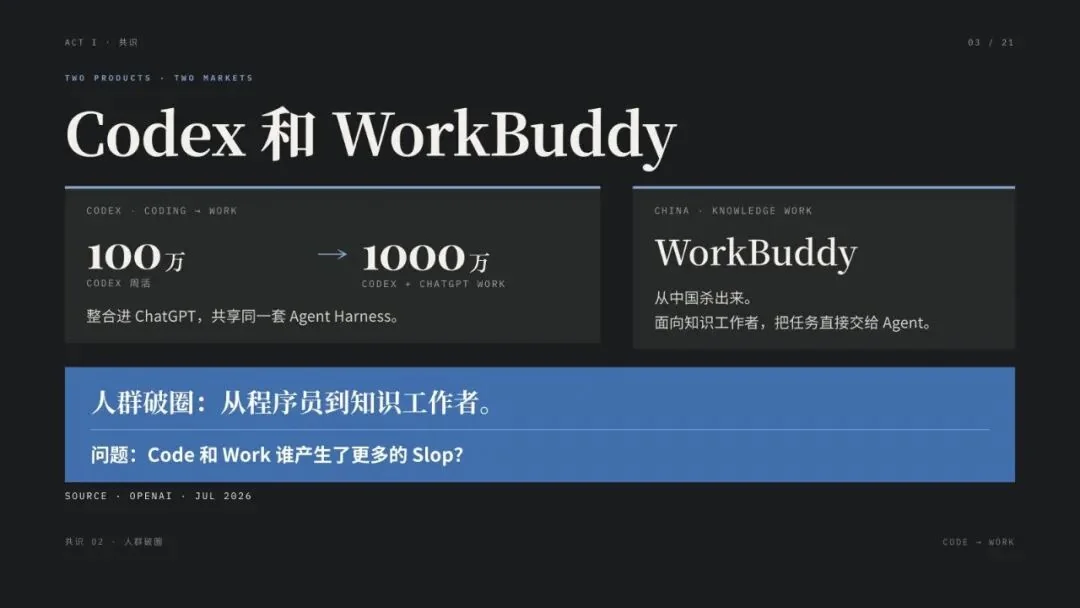
Next, Codex and WorkBuddy. In six months, Codex grew from about 1 million weekly active users to about 10 million. In China, WorkBuddy’s monthly usage soared to 20 million, a truly striking number.
The first thing I see is that agents are breaking out of the programmer community and reaching knowledge workers.
Many people use agents to write a great deal of code every day, but the code and software they write are not the final result, only intermediate products. When knowledge workers use Codex or WorkBuddy to complete a specific task, the output often corresponds directly to a result. For example, when I use it to make a deck, the work is done when the deck is done. But if I write a piece of software that nobody uses and that cannot be sold, then apart from my own use it has produced no final result value.
I once discussed this in a group chat with Yubo, Jigang, and Juzi: which is the “digital slop,” the code or the final work? My angle was this: did you only complete an intermediate step, or did you use it to solve a problem and get a result? The two are very different.
Some programmers use agents like crazy and end up with nothing but their own satisfaction, without creating other result value. Conversely, many knowledge workers who don’t understand code really have solved real problems with these tools.
Super agents are unifying entry points
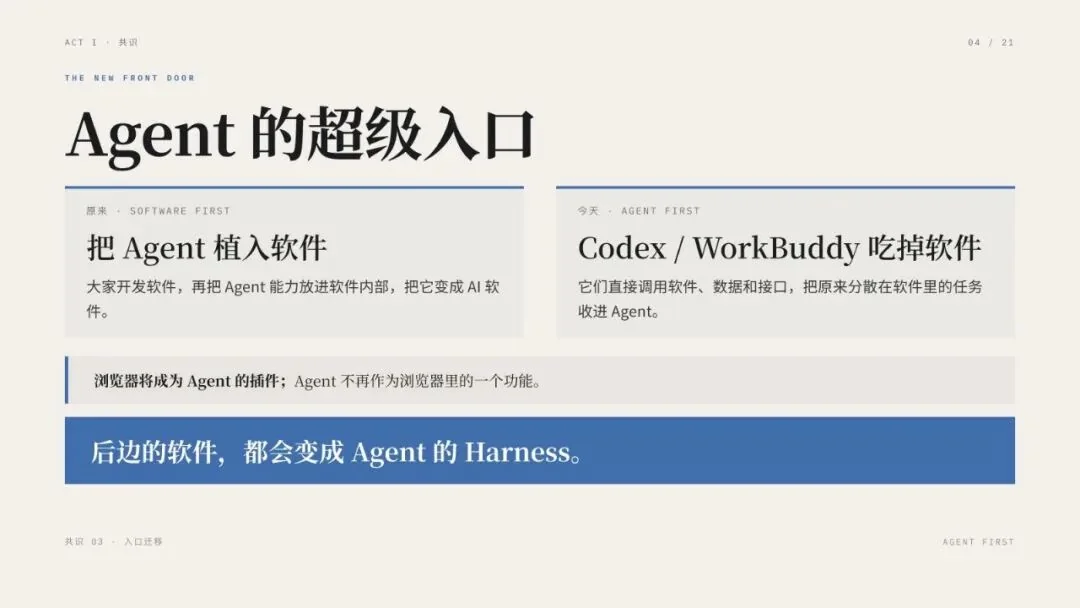
Most of you here probably believe that in the future a super agent will serve as the unified entry point. But over the past few years, although we believed this, we acted in exactly the opposite way. Most software practitioners and product managers tried to add AI and agents to their own software, while the future we believed in was one where a super agent unifies all entry points. The two contradict each other; what we knew and what we did did not match.
Starting this year, super agents are taking up more and more of our time and gradually eating other entry points. I used to log in to websites myself to do many things; now I just state my needs to an agent, and it can complete them with computer use or browser use. In the future I may spend less and less time using software directly: some problems the agent will solve itself, others it will solve by operating other software. Our understanding and our actions are gradually converging in the same direction.
A year or two ago, both Claude and Codex were building Chrome extensions: users called ChatGPT or Claude inside the browser and let them operate web pages. Later OpenAI released a browser product, Atlas, and recently shut it down. The recommended approach now is to open web pages in Codex’s built-in browser, give your request straight to Codex, and let Codex operate its internal browser to complete the task. This shows that agents are preparing to bring one of the most important pieces of software on the computer, the browser, inside themselves.
I think this is a huge paradigm shift that began around the middle of this year.
Another example. ChatCut is a video editing product. Doing complex editing in CapCut is very tedious and not friendly to people. ChatCut built a Codex plugin that packages complex editing capabilities into Codex as a plugin. Users no longer need to drag and click with the mouse; they just tell Codex how they want to edit, and Codex calls ChatCut’s features through the plugin to complete the task.
For decades, most software feature code has been solving human-computer interaction: letting people see information on a screen and operate software with a mouse and keyboard to get things done. In the example just now, you tell Codex or another agent what you need, and it handles all the complex interaction and completes the task directly. This may bring about a huge transformation.
If this judgment holds, the importance of software as an independent deliverable and an independent carrier of value will fall sharply. Software will gradually become part of the agent harness rather than an independent entity.
The relationship between software and agents will flip
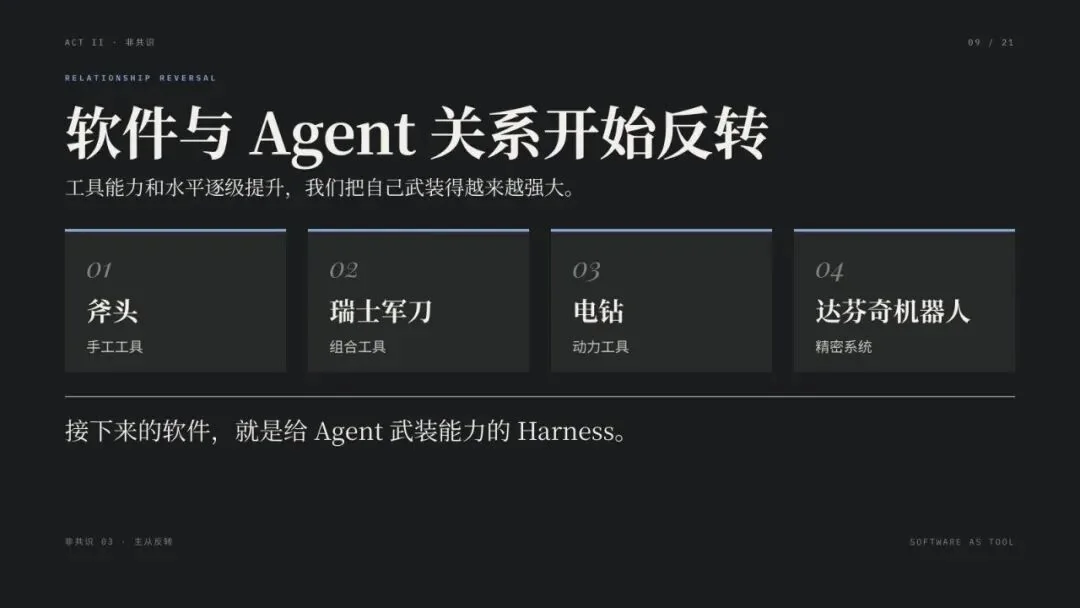
I think the relationship between software and agents may start to flip. Over the past year or two, many people built lots of small pieces of software, either for themselves or to sell. But from here on, building software and then distributing and selling it may get harder and harder. Securing a plugin slot on platforms such as Codex and WorkBuddy may instead be more valuable strategically.
If the capabilities we build can be used by people and also called by people’s agents, they may still have value. But this requires us to rethink the form of software.
AI-native organizations are not local optimizations but a complete rebuild

In a single month this April, I gave executive and all-hands talks at four companies, Meituan, Tencent, Baidu, and Ant Group, on transforming into AI-native organizations. Looking back four months later, there may be a new iteration today.
Our original organizational structure divided a square or rectangular organization vertically, and the change is to divide it horizontally instead. Traditional organizations are divided into departments, and within departments, work is split by position and role. This is a static structure, and its dynamic operation relies on internal processes. Organizations were divided this way because people’s abilities and the context they hold are limited: some are good at product, some at development, some at testing, so different abilities and different context had to be placed in different positions.
With AI’s help, human memory can be augmented, and if context is built well enough, the boundaries of human ability expand too. Organizations do not have to be cut only vertically; they can also be cut horizontally.
But what this slide really wants to say is that what organizations face today is not just a change in work, roles, or processes, but the rebuilding of the entire organization. Every part has to be adjusted together. If processes stay the same and you only improve individual positions, or only adjust roles, that is not enough to build an AI-native organization. There is no solution that completes organizational transformation by fixing a single point.
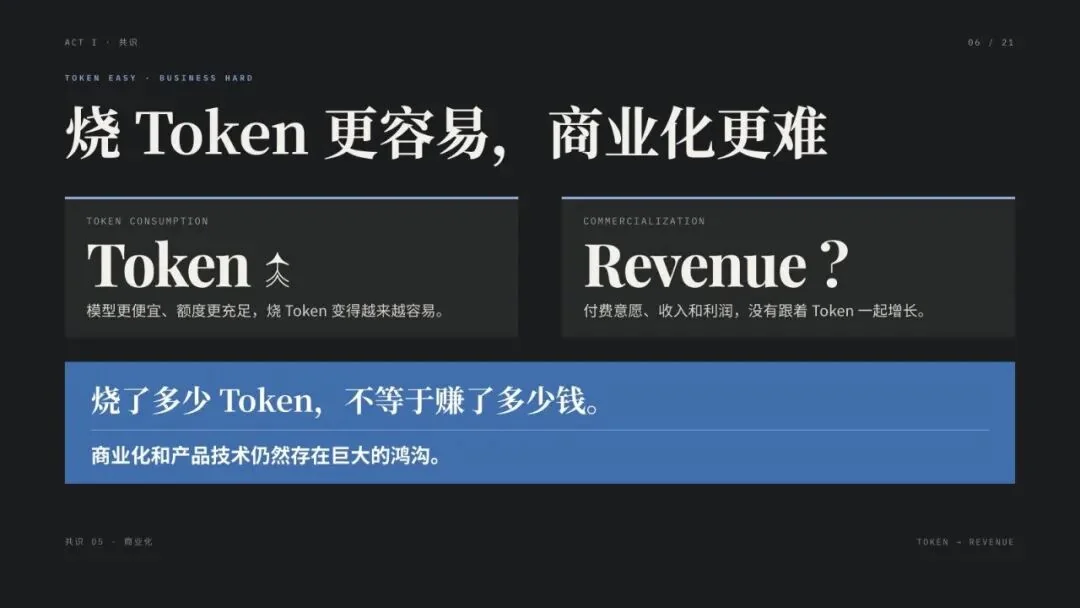
We often say that burning tokens is easy; commercialization is hard. A huge gap has always existed between product, technology, and commercialization, and that has not changed today. It is just that AI has greatly reduced the cost and time of product and technology and greatly improved their efficiency, so the business problem stands out more.
Before, 100 companies built products and 100 companies solved business problems. Today perhaps 10,000 people build products, but still only 100 companies can solve business problems, which is why we feel this gap so strongly. From here on, we cannot only let AI help us create more products and solve more technical problems; we also need AI to help us complete the commercialization half.
The more capable agents become, the more managers need to change themselves

When you hire a group of “PhD students” who are ten or a hundred times more efficient, and your own way of working does not change, the one who most needs to change is actually you. That is exactly our relationship with agents today.
The more capable agents become, the more we should bring our attention back to the most essential questions: how to define our own goals, how to define the agent’s goals, how to coordinate our relationship, and how to prepare better and more context for the agent so it works better.
In the past, we spent too much energy marveling at, trying out, and practicing what agents could bring, and too little starting from ourselves to improve our own management style and our collaboration with agents.
Xiaoqi has already spent an hour on context, and we discussed it a lot in my previous talk as well. I will emphasize only one point: make context compound. Agents can be swapped, but context cannot be replaced. Xiaoqi was pointing in the same direction: help users hold on to their context, then use agents to build compounding returns on it.
Designing software for people and agents at the same time

If people will use software through agents in the future, the software industry needs to rethink a question: what kind of software can be used efficiently by agents and smoothly by people?
Past software was either designed for people or, as in a recently popular direction, designed specifically for agents. What we need now is another form: people can see it, participate when necessary, and have a good experience using it; agents can call it quickly and conveniently. The industry as a whole may not yet have seriously considered what this kind of software should look like. I have been mulling it over lately.
Take WeChat as an example. Something that takes an hour to do yourself might, if WeChat were connected to an agent, take just one sentence and 40 seconds. Sending personalized New Year’s greetings to every relative and friend in a group on Spring Festival Eve might take a whole night by hand; if WeChat were designed for both people and agents, it would be easy. WeChat is just an example; almost all software can be redesigned this way.
Several meanings of “software is dead”
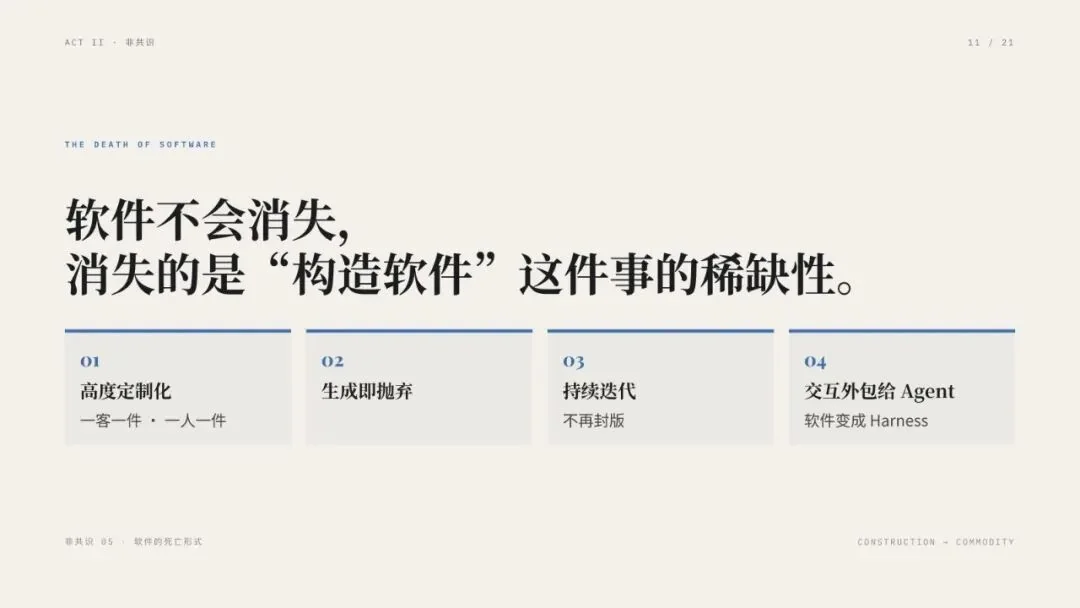
My original title for this topic was “Software is dead,” and later I had an agent change it. Software can actually “die” in many ways.
This Monday I chatted with the founder of a company with annual revenue in the hundreds of millions of dollars. He has many enterprise customers and wants to use AI to run long-term B2B business for them. He opened by saying, “I use AI to build products or software for these companies to solve certain problems.” I immediately interrupted him: that sentence still carries the legacy thinking of the software era, not the thinking of the AI era, because what he was still imagining was using AI to make a software product and then selling it to customers.
We used to need to make apps, write software, and build SaaS because productivity was limited. To replicate at scale, we could only abstract heavily and look for the greatest common divisor of user needs. Every app, piece of software, or SaaS service customers bought could meet only some of their needs: some 80%, some 50%, some 20%, but they were still willing to pay.
The production cycle of traditional software is also long: research, user interviews, understanding requirements, production, delivery, and then, when users find it hard to use, another round of feedback. It often runs on a cycle of years. AI is completely changing this.
Software will ultimately become the harness through which we deliver results to customers. What we produce with AI today is a harness that helps a specific customer achieve results. It is hard to call that traditional software anymore, because it is one per customer, one per person. Traditional software makes one copy and sells countless copies; if you make a customized, truly useful thing for each customer and each person, it is no longer an app, software, or SaaS in the traditional sense. From this perspective, software may already be dead.
The second way it dies is “generate and discard.” To solve a problem this one time, you have AI write something, and once the task is done you may never use it again, but that is fine because the cost is already low enough. If such one-off output is also defined as software, it dies the moment it is generated.
The third way it dies is “no more version freezes.” Software no longer needs version numbers. In the past, a version had to be frozen, tested, regression-tested, and validated before the same copy was sold. If software becomes a continuously rolling harness, one per customer, there is no need to freeze versions or assign version numbers.
The fourth way it dies is that many problems no longer require buying a separate piece of software. Just now, while I was revising my slides, my laptop was very hot. I simply asked Codex to fix it. It found a batch of orphaned Chrome processes and closed them, and the computer quickly cooled down. There was no need to buy software dedicated to finding processes with high CPU usage; an agent solved it directly.
These changes will have a huge impact on the software industry.
What is vertical is not the agent itself

Many people are exploring vertical agents. My view is simple: what exactly is vertical? Not the agent, and not the software or the harness. What is truly vertical is what lies outside the model: data, interfaces, results, and closed-loop commercialization capability. Vertical value does not lie in the agent itself.
Treating agents as people is both right and wrong

In the first half of this year, at an in-person GeekPark event, I said something rather grandiose: today, treating agents as people is right; but treating agents as people is also wrong.
Before agents appeared, we had never faced something that could work, think, execute, and complete tasks like a person. In 2026 many people still think large models and agents are merely tools. The first half of the sentence reminds everyone not to treat agents only as tools. Only by treating them as people can we discover uses that are completely different from traditional software and traditional programs.
But once you treat them as people, you must also realize that they are not the same as people. They may work a hundred times faster than you; once you become “colleagues,” you may be the one holding things back. We need the ability to manage agents. The first half helps us break through one layer of understanding, and the second half asks us to understand how they differ from people as we use them. These are two different layers of understanding.
Finding compounding constants amid continuous change

The founder I mentioned earlier said he wanted to do something long-term. After breaking his “build software and sell it to customers” mindset, I asked him a question: since ChatGPT was released, what has stayed the same over these years? The answer is that continuous change itself is the only thing that has stayed the same.
Technology, products, scenarios, and the results we pursue keep rolling forward. Only if a team and an organization build a capability that can keep rolling forward do they have a chance to stay at the table today. If you decide now to build a piece of software to sell, the rolling cycle suddenly becomes months or even years. But if you make it a continuously rolling harness, it can be adjusted at any time, with no versions and no version numbers, only constant forward movement.
Change is the constant. At the same time, we also need to find what can compound beyond change. That other constant is context: the asset that persists over time as harnesses and agents keep rolling.
High consensus is big companies’ comfort zone

At a panel this morning, someone asked how I felt about the first half of the year. I said the first half was particularly boring, because almost everything was consensus: token usage kept growing, models kept launching faster with stronger capabilities, and new agents appeared every day; everyone had an agent, every company was building agents, and Xiaoqi was building context. The direction did not change; only the numbers did, bigger and faster.
Entrepreneurs need to realize: once a market reaches high consensus, it enters the territory of big companies. Big companies can advertise on every screen where users appear and make sure everyone sees it. Once consensus is reached, you are in the comfort zone of Tencent, Alibaba, and ByteDance.
There is another question worth thinking about: if large models and agents undergo a huge change every three months, do you also change the way you work every three months? If not, something is definitely wrong. When tools change dramatically, the way you use them and your whole working method should change with them.
Try picking up a piece of work you set aside six months ago and running it again with today’s models and agents. After that experience, learn to iterate yourself along with them: which things you used to do can now be handed to agents, and which things you wanted to do but could not before can now be completed by them, while you take another step forward and think about new problems.
FDE is an old methodology and a new training opportunity
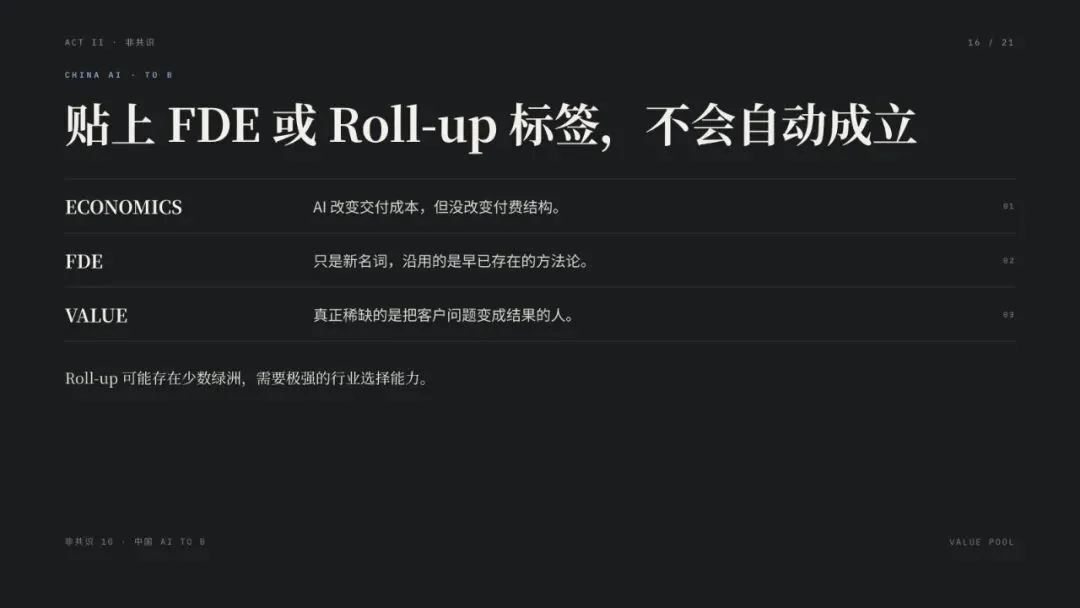
FDE has been very popular lately. But for a B2B entrepreneur with more than ten years of experience, FDE is a very old methodology. People who really got B2B right have always worked this way; it has just become popular again under a new name.
Ten years ago, people with real FDE capability were extremely rare, and that will not suddenly change today. So I predict that FDE will very likely be quietly swapped for another concept: outsourcing and custom development. The things everyone least wanted to do in the past are coming back in FDE clothing.
I once wrote a line in flomo: “We need a Peking University Jade Bird for the FDE era.” This is not a joke; I think there is a huge business opportunity in it.
In the internet era, Peking University Jade Bird trained, at scale, people who had not gone to university but wanted to learn software development, and sent them to all kinds of companies. Many people I know who had little formal education and graduated from Jade Bird later became talented professionals and got results. Something similar happened in the mobile internet era: around 2010, a group of institutions trained Android and iOS developers at scale.
Today, training and developing people who can put AI applications into practice at scale is equally valuable, from both a business and a social perspective. It can absolutely wear FDE clothing, since real FDE has always been hard to do well, then and now.
When technology gets cheap, what gets expensive

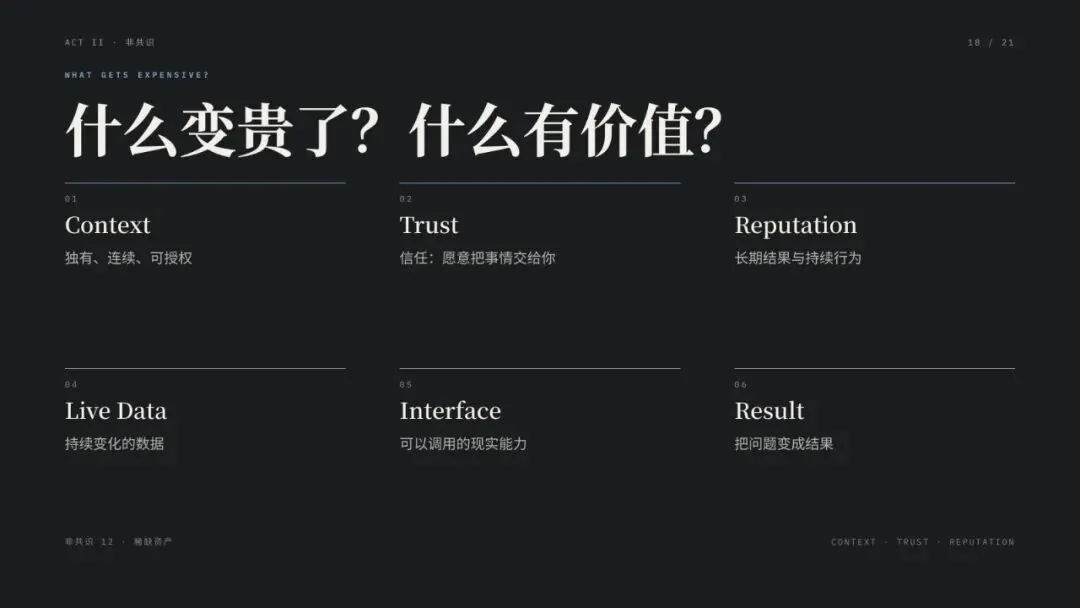
If building products and solving technical problems becomes simpler, cheaper, and faster, what becomes expensive? The items I listed come from different dimensions and are not all of the same kind, but they are all worth attention: context, trust, reputation, live data, interface capabilities, and results.
Trust is becoming more important than ever. In the past, when a client needed to solve a problem, perhaps five suppliers came knocking and the client could choose one. Today perhaps 500 people say they can solve it; whom should the client choose? That is a huge problem for clients.
From the supplier’s side: why do I use Guizang’s PPT Skill? Many people make PPT skills, but I know Guizang, and Guizang has a reputation with me. The premise of this judgment is that something only five people could do in the past can now be done by 50,000. After supply explodes, trust becomes even scarcer.
Another dimension is what lies outside the model. Models are strong, but we are neither Yang Zhilin nor Tang Jie; we will not build foundation models ourselves. What really matters to us are the assets outside the model.
The first is live data, data that is continuously active and changing in real time. This data neither can nor needs to be trained into models. For example, ask a large model about the weather in Beijing on August 8, 2026, and it may give an approximate answer; but ask about the actual weather outside right now, and the model itself does not know. Capital markets are the same: a model can speculate about a full year’s stock trend but does not know NVIDIA’s exact share price at this moment. These are all live data.
The second is interfaces and capabilities. For agents to interact with the digital and physical worlds, they must have the corresponding interfaces and execution capabilities. This also lies outside the model.
The third is results. Finishing a program is not a result; it may only give you a sense of satisfaction. Only actually solving a problem for yourself or others counts as a result.
The age of everyone as an inventor
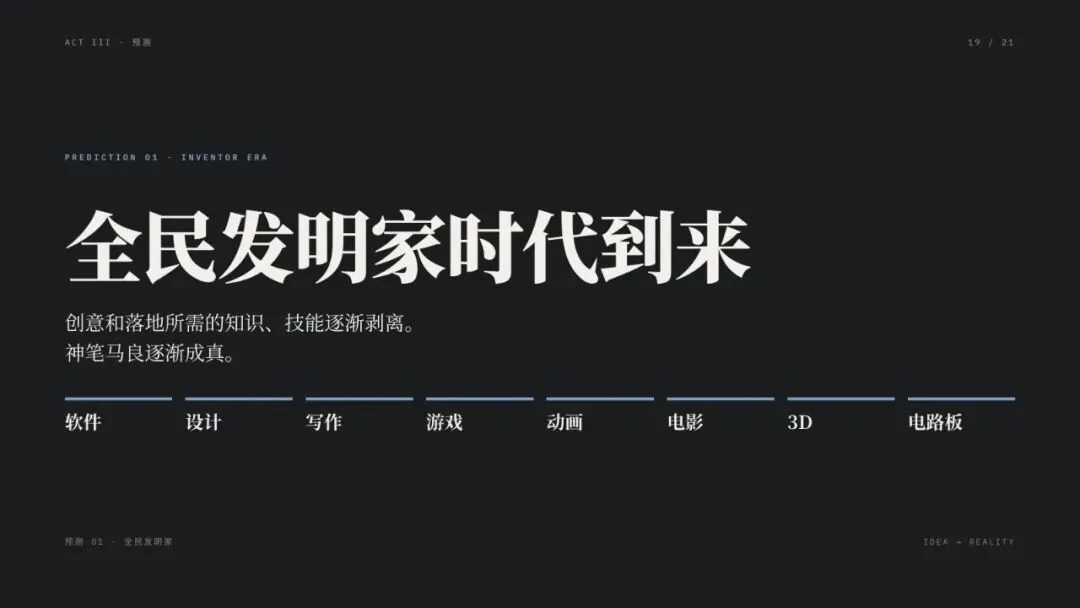
I have been thinking about one question lately. If you scroll Xiaohongshu often, you can probably feel a trend sweeping in: the age of everyone as an inventor is arriving.
Many ordinary people without professional training can now do, with AI’s help, things they could not do before. I have always been a geek, tinkering with circuits, microcontrollers, and components in my spare time, but I never studied them systematically. In the past I had to read manuals and find online tutorials; today I can have AI design circuits for me and tell me exactly what to do.
3D printing is the same. Why have the valuations and market caps of 3D printing companies risen in the past two years, and why has the technology suddenly accelerated? A few years ago the technology stagnated, not because the industry lacked the technology, but because the market was too small to justify investing resources to push it further.
Once supply and demand explode at the same time, the flywheel starts: participants invest resources to solve technical problems, and iteration speeds up rapidly. One of the biggest difficulties in 3D printing used to be that there were not enough models worth printing. Today, 3D model companies such as Tripo and Meshy are getting attention precisely because they can solve the supply problem at scale.
If the narrative of “the age of everyone as an inventor” holds, many new opportunities will emerge in it. I don’t know exactly what they are yet, but they are worth continuing to look for.
DeepSeek brings not a price cut but a cost breakthrough
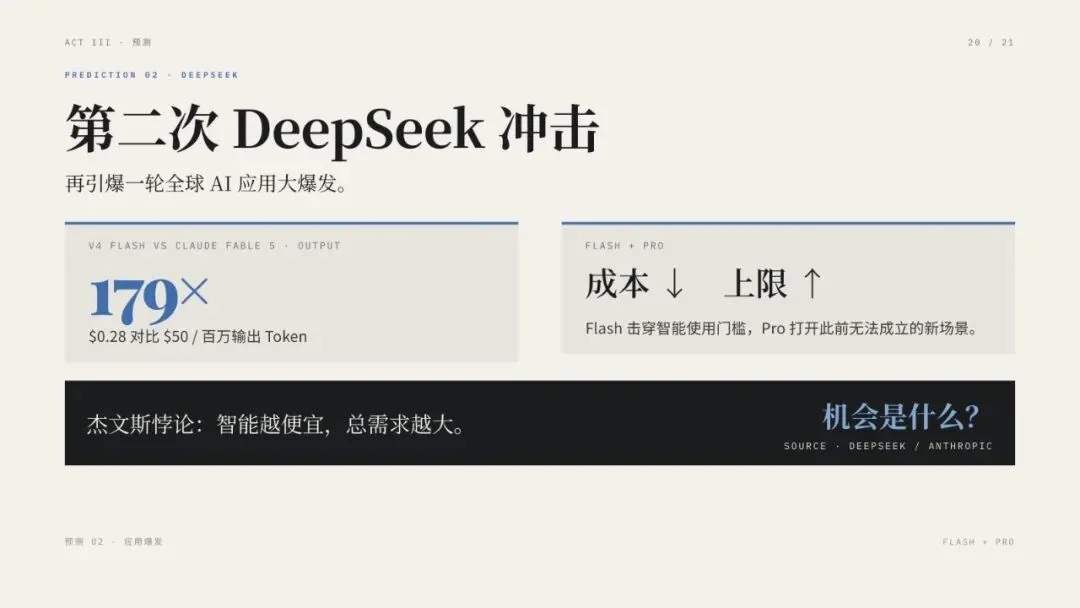
Finally, a question the whole industry still does not clearly understand. I think this round of disruption began with the official release of DeepSeek V4 Flash, and the real explosion will be the release of the Pro version. If DeepSeek does not slip, the Pro version is expected the day after tomorrow, August 10; of course, it may slip again.
Recall DeepSeek’s previous round, the releases of V3 and R1, about a month apart. This time, setting quality aside, on price alone the gap reaches 179 times. In the past, when we said Zhipu’s models or Kimi were cheaper than Opus, the gap was usually about ten times. Ten times was already enough to bring huge change, but this time DeepSeek pushed the gap to a hundredfold.
A hundredfold gap will shock the entire industry. What I care about is not how much model prices have dropped. Many people discuss how much it will force Anthropic or OpenAI to cut prices, but that is neither the biggest problem nor the biggest opportunity, because a price cut alone creates no additional value.
The real additional value comes from a cost breakthrough: scenarios that used to be unaffordable because models were too expensive are now becoming feasible. This will expand scenarios and markets.
Now that DeepSeek has brought prices down to this level, much of the context I used to be unwilling to spend tokens on, and information I was unwilling to mine, can now be processed. For example, I accumulate a great deal of WeChat context every day. In the past I was reluctant to spend tokens and asked only a few questions at most; today I can ask from 100 different angles and mine all the information in my daily WeChat context.
When DeepSeek cuts costs by 100 times, I have the chance to extract 100 times the value from the same asset. I think this, rather than making OpenAI and Opus cut prices, is the biggest shock and transformation it will bring to the industry. The latter has little to do with you and me.

I hope this resonates with you, but none of it is investment advice. I am not offering a complete industry review, only sharing the questions I truly care about; there are many areas outside my focus.